SAN DIEGO — Marriage enrichment is “at the heart of evangelization.”
That’s what John Prust, director of the diocesan Office for Family Life and Spirituality, said reflecting on the office’s emphasis on programs that foster improved communication between spouses and equip them with practical skills for healthier marriages.
The office was created in 2017, a fruit of the diocesan synod on the family. He said that the office “focused a lot on marriage prep in the first few years,” not having “the bandwidth to really dive into marriage enrichment.”
But now, having revamped the diocese’s approach to preparing engaged couples for the sacrament of matrimony, the office has been able to shift focus.
Last year, the office introduced Adventures in Marriage, a four-week training in marriage skills, which has been offered five times in the diocese — twice in English and three times in Spanish.
More recently, the office welcomed CoupleTalk, another marriage skills workshop, to San Diego. The first six-week series in the diocese will be held on Tuesday nights, Jan. 20 to Feb. 24, at St. Catherine Laboure Parish in Clairemont, from 6:30 to 8:30 p.m.
Funded through a federal grant, CoupleTalk has been made available to 30 participating couples at no charge, including workbooks, free childcare and even a $100 gift card for those couples who attend all six sessions.
Don and Alex Flecky, who are based in Fullerton, California, founded CoupleTalk, which is billed as the “21st century version” of the Relationship Enhancement (RE) model developed by Drs. Bernard and Louise Guerney more than 50 years ago.
The Fleckys first encountered Relationship Enhancement as participants. They were so enthusiastic about the program that they soon were teaching it, first at the church where Don is a minister with the Evangelical Free Church of America. The couple eventually was invited by the Relationship Enhancement parent organization to create a Christian version; the original hadn’t included any faith content.
The repackaged version, now known as CoupleTalk, has since spread to all 50 states and to 20 other countries.
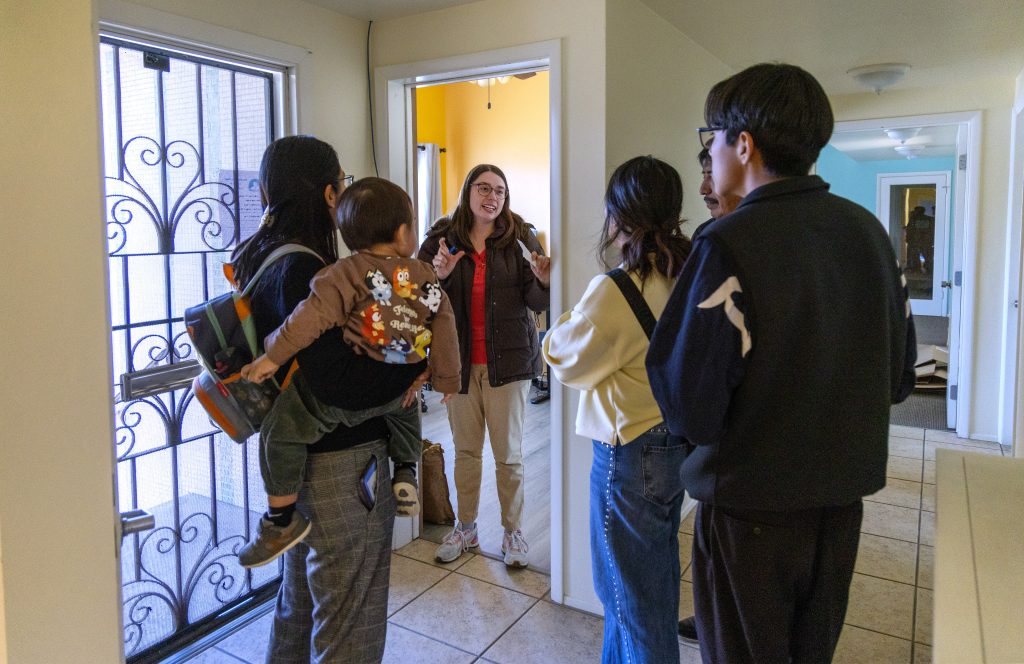
Explaining the format of the program, the Fleckys said that CoupleTalk presenters will give a short teaching, demonstrating a particular communication skill or conflict-resolution skill, and then have the participating couples themselves practice the exercise, followed by a debrief. Coaches will roam the room, assisting couples.
“One of the skills that we love to teach … is giving appreciation,” Don said, explaining that most of us have a tendency to be more open about “the things that bug us” than about “the things that I am grateful for.”
Another skill, Alex said, is “listening with empathy,” which involves listening to what your spouse is saying, and being able to summarize back what she said, rather than thinking ahead to what you’re going to say next.
Don said that another skill — and one that he had remembered having to put into practice about a week earlier — was a concept call “a redo.” When you realize that you said something sarcastic or critical to your spouse, you can ask for “a redo” and express yourself in a more respectful way.
CoupleTalk has been awarded the “Helping Every Area of Relationships Thrive” (HEART) grant, through the U.S. Administration for Children and Families. They will receive $750,000 annually for five years to offer the workshops through Protestant and Catholic churches and organizations in six California counties, including San Diego.
Prust said that, for him and his staff, the response to CoupleTalk has “blown us away.”
He said that they capped registration for this first series at around 30 people and still have 44 couples on a waiting list.
Though each session of Adventures in Marriage was kept to around 15 couples, he said, they had to close registration a few weeks before those as well.
“I feel like we’re touching this pent-up demand,” said Prust. “There’s clearly a lot of interest for this.”
He said that they accepted so many participants for this inaugural CoupleTalk series, because he hopes to get “a lot of potential teachers” from among the participants.
“Once you go through it, you can get trained to teach it yourself and lead it yourself. And the training is pretty minimal,” Prust said.
He sees this as “something that could grow … exponentially.”
Don Flecky said that the plan is to offer a second CoupleTalk series in the Diocese of San Diego in either April or May. After that, the goal is for a new one to launch every month in a different area of the diocese.
Underscoring the value of – and great need for – marriage enrichment programming, Prust cited statistics compiled by the nonprofit ministry Communio. Those statistics show that, while a low percentage of Christian churches include marriage ministry in their budgets, those ministries pay dividends for churches that do.
“One of the statistics that Communio tosses around a lot is that 80 to 90% of the people in the pews on any given Sunday come from intact families,” said Prust. “They’re showing the link between … passing on the faith from one generation to the next and a healthy marriage.”
He explained that the Church considers parents to be the “primary catechists” of their children, but that this is often done through “a soft catechesis,” less through classroom-style lessons than through “teaching their kids what healthy relationships look like, teaching their kids who they are as children of God made in God’s image.”
“Studies clearly show that it will bear fruit,” Prust said of marriage enrichment programs like Adventures in Marriage and CoupleTalk. “It’s a worthy investment. It’s not just something we’re doing because we want to be nice and we want to help couples speak nicely to each other. This is at the heart of passing on the faith from one generation to the next. It’s the heart of what can make a parish really come alive in a way.”
William and Marianne Roetzheim, both 70, have been married for 46 years.
The Roetzheims attended Adventures in Marriage last September and, since then, have gone through the required training to serve as facilitators.
Marianne said, “As a married couple, we’re going to need to communicate about some tough issues. We can’t just ignore them. The classes teach skills that make those tough topics easier to tackle. They help us communicate with each other in a more positive, constructive way.”
She believes that “just making the commitment” to attend the sessions together represents “a commitment to each other and to the marital sacrament.”
William offered some thoughts for those who might believe that a marriage enrichment program like Adventures in Marriage is nothing that a happily married couple would need.
“That’s sort of like saying, ‘I already know how to dance, so why go out dancing,’” he said. “I feel like marriage enrichment is something that we should do throughout our married life, because it’s fun. Even if I knew absolutely everything about Marianne right at this moment, in another month she’ll be a different person and I’ll want to get to know that person as well.”
Renelynne Montehermoso, 52, and her husband, Ron, 56, have been married for almost 30 years. Like the Roetzheims, they also went through Adventures in Marriage and went on to be trained as facilitators.
“My husband and I were looking for something that would enhance our relationship as a married couple,” said Renelynne, who learned about the program through the Facebook page of the Office for Family Life and Spirituality. “Sometimes, I felt our family and marriage routine was becoming too ‘routine,’ where we weren’t on the same page or wavelength emotionally.”
“The program was great,” Ron said. “It provided us with great tools that helped each other communicate with respect and without escalation.”
“After the program,” he said, “we realized, in certain ways, both of us were both disconnected and not realizing we were actually distant. Using the tools from (Adventures in Marriage), it allowed us to reconnect with one another.”
Prust said that he still believes that there is “a stigma” surrounding marriage enrichment, with people thinking that “the only couples that go to something like this are the ones that are struggling, or they’re on their ropes, or they’re close to divorce.”
“One of the things we want to do with this is just start to normalize the fact that in any healthy marriage, just like if you buy a car and you need to get oil changes now and then, you maintain it. And in the same way, you need to maintain your communication skills.”
He recalled some advice that he received from his dad around the time that he got married. His dad told him that “marriage isn’t just about falling in love once; it’s about falling in love again, and again, and again.”
What allows for spouses to fall in love over again is doing the requisite work.
With CoupleTalk and Adventures in Marriage, Prust believes that his office now has “multiple tools in our toolbox.”
He explained once again how important the practical component of these marriage enrichment programs is.
“We teach our engaged couples that, in getting married in the Church, you are promising to love this person the way Christ loves you,” he said. “And we can say that again, and again, and again and talk about the beauty of … the vocation of marriage.”
But, he added, the Church must “take some time to help couples learn how to do that.”
“There can be the will, but you may not know the way,” he said, “especially for couples maybe who grew up in homes that were difficult, in broken families and divorced families and not knowing or being afraid to trust and just how critical it is that we do that.”
“We’re not just teaching them healthy communication,” he said. “We’re teaching them to experience grace. We’re teaching them to experience God. And that’s what marriage is supposed to be. … All of our close family relationships should reflect the love that God has for us.”