SAN DIEGO — The inmates of three state prisons recently welcomed some special guests.
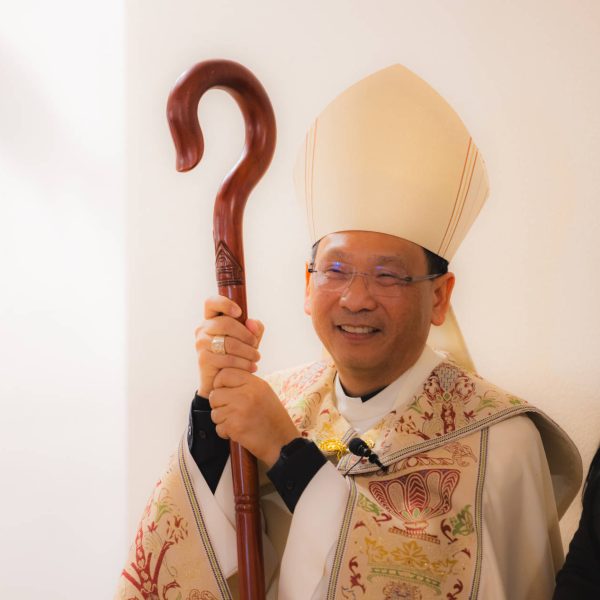
Auxiliary Bishop Felipe Pulido visited California State Prison, Centinela, located in Imperial County, on Dec. 17. Bishop Michael Pham went to the Richard J. Donovan Correctional Facility, located near Otay Mesa, Dec. 20. Auxiliary Bishop Ramón Bejarano visited Calipatria State Prison, also located in Imperial County, on Dec. 22.
At each prison, a bishop visited two of the four yards, celebrating a Mass in each, as well as hearing inmates’ confessions.
Deacon Robert “Bobby” Ehnow, director of the diocesan Office for Life, Peace and Justice, accompanied the bishops on their visits and said that they heard confessions “for a couple of hours each,” having allotted about an hour and a half in each yard.
During the Masses, the bishops also baptized and confirmed any inmates who had been prepared to receive those sacraments.
The three bishops’ visits were scheduled to coincide as closely as possible with the Jubilee of Prisoners, Dec. 13 and 14, a worldwide observance that was among the final events of the Jubilee Year that concluded on Jan. 6.
“Just like you and me, they’re God’s children,” Deacon Ehnow said of the inmates, reflecting on why it’s important for the Church to minister to them. “They’re God’s children that are separated physically from us. Sometimes, that separation can feel like they’re invisible; they’re not, obviously.”
He said that a visit from a priest or a bishop is “a big deal” for them because, despite being able to attend a weekly Communion service and Bible study, they only infrequently are able to go to confession or attend Mass.
“In all the prisons and all the yards, there was a deep sense of gratitude and appreciation that the bishops were present with them,” he said.
Deacon Freddie Thornton, who has served as Catholic chaplain at Centinela State Prison for about five and a half years, noticed that “quite a few” of the inmates, especially those receiving baptism, “had tears in their eyes because it was something they were longing for.”
Deacon Thornton shared that one of the inmates who made his confession to Bishop Pulido had gone more than three decades since last receiving the sacrament of reconciliation.
“He’s a big man, gangster, all tatted up, a really scary-looking guy,” he said of the inmate, whom he described as “a lifer” sentenced for murder.
Deacon Thornton said that the inmate had been “really nervous” about making his confession. But after receiving absolution, the deacon said, he was “dancing around” with “this big old smile on his face.”
He said that the inmate told him, “I didn’t go (to confession) before because I didn’t think God would forgive me for what I had done. And, after talking to you and the bishop, I believe that this forgiveness is real, that Jesus has forgiven me.”
Deacon Thornton said that the inmate told him that, despite knowing that he will spend the rest of his life in prison, he believes he can now “live my life in peace and with joy in my heart.”
“That brought me tears, I’ll be honest with you,” the deacon said.
Bishop Pulido visits RJ Donovan Correctional Facility every month.
Reflecting on his December visit to Centinela State Prison, he acknowledged that prison ministry can be “intimidating” at first.
But, during their confessions, he said, “They tell me everything, because there’s nothing to hide. They’re very honest. I see the graces now, and that really put me at ease because I see their humanity, not so much the image they have.”
Bishop Pulido said that, while many of the men “look very tough,” he found them to be “very human.” Some even cried as they told him their stories.
After hearing confessions, one inmate told him that it had been five years since a priest had visited. The inmate joked that, hopefully, Bishop Pulido could return in another year or two, “so, when you come, we don’t have too many sins.”
In the second yard that Bishop Pulido visited, three inmates received baptism, confirmation and First Communion.
The bishop asked the inmates to tell him how many people were present as the sacraments were administered. The inmates said that there were 16. The bishop asked if they remembered the movie “Sixteen Candles” and, when they affirmed that they did, he said, “You’re 16 candles. Now, be a light out there” in the darkness.
For Bishop Pham, the visit to RJ Donovan Correctional Facility was a long time coming.
“When I became a priest, this is one of the ministries that I wanted to do,” he said of prison ministry.
But, after having gone through all of the necessary training, it somehow fell through and he was never able to do it.
Upon arriving at the prison, Bishop Pham admitted to feeling “trepidation” and wondered what the experience would be like and how he would be received by the inmates.
“I was surprised when I celebrated the Mass,” he said. “These inmates seemed very in tune with the celebration. They responded to the Mass much more enthusiastic than I may have noticed at some parish.”
Just prior to his departure, Bishop Pham recalled, one inmate gave him a note and asked him to pray for his uncle, who had recently died.
“The fact that the man has this tremendous faith and … (asked) me to pray for his uncle, that’s a memorable moment,” he said. “And I remembered to pray and celebrated the Mass for this request.”
Bishop Bejarano said that visiting a prison is “not an easy experience, when you hear the metal gates close behind you.”
“I understand that I’m entering a different environment, where people have been deprived of freedom for many different reasons — a number of them for murder or other crimes — but I also feel safe,” he said. “I have experienced a lot of respect and gratitude every time I have visited a prison. The inmates express a thankful heart for the opportunity to have someone to hear their confession and for the Eucharist.”
“The most beautiful experience for me is not listening to their sorrow for the wrong they committed, but by the conversion I myself experience,” he said. “They are beautiful human beings, a real person who is loved by God with the same love he has for each one of us. They are not afraid or embarrassed to express their inner feelings and shed some tears.”
He said, “Seeing the inmates gathered to pray and celebrate the Eucharist gives me lots of hope.”