SAN DIEGO — “The Spirit is already alive here.”
That’s what a leading voice at the Vatican, Sister Nathalie Becquart, affirmed during a recent visit to the Diocese of San Diego.
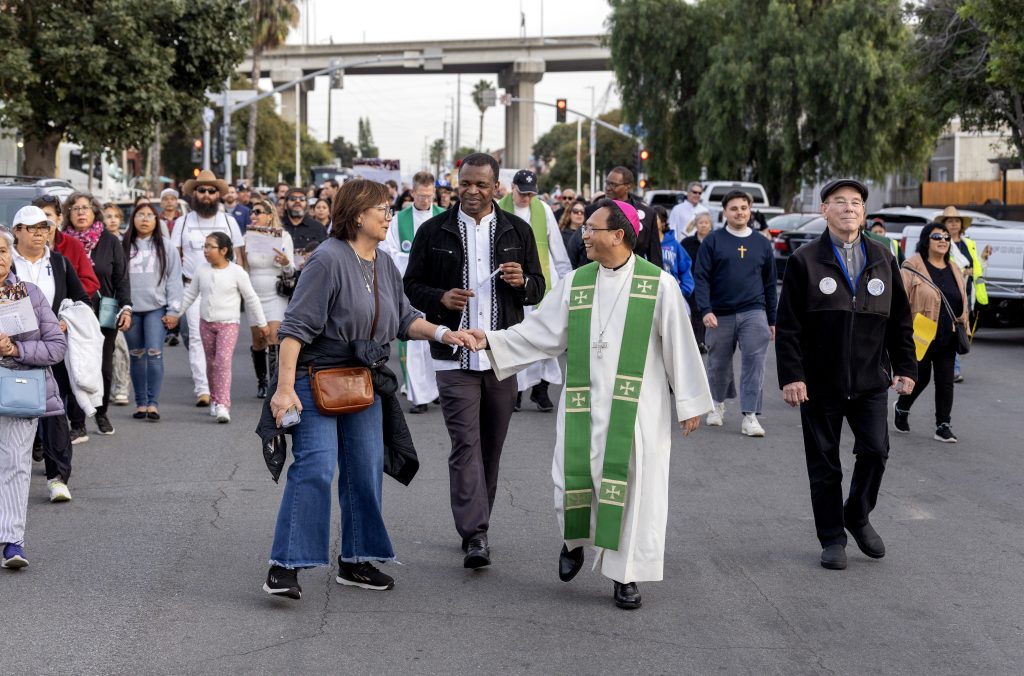
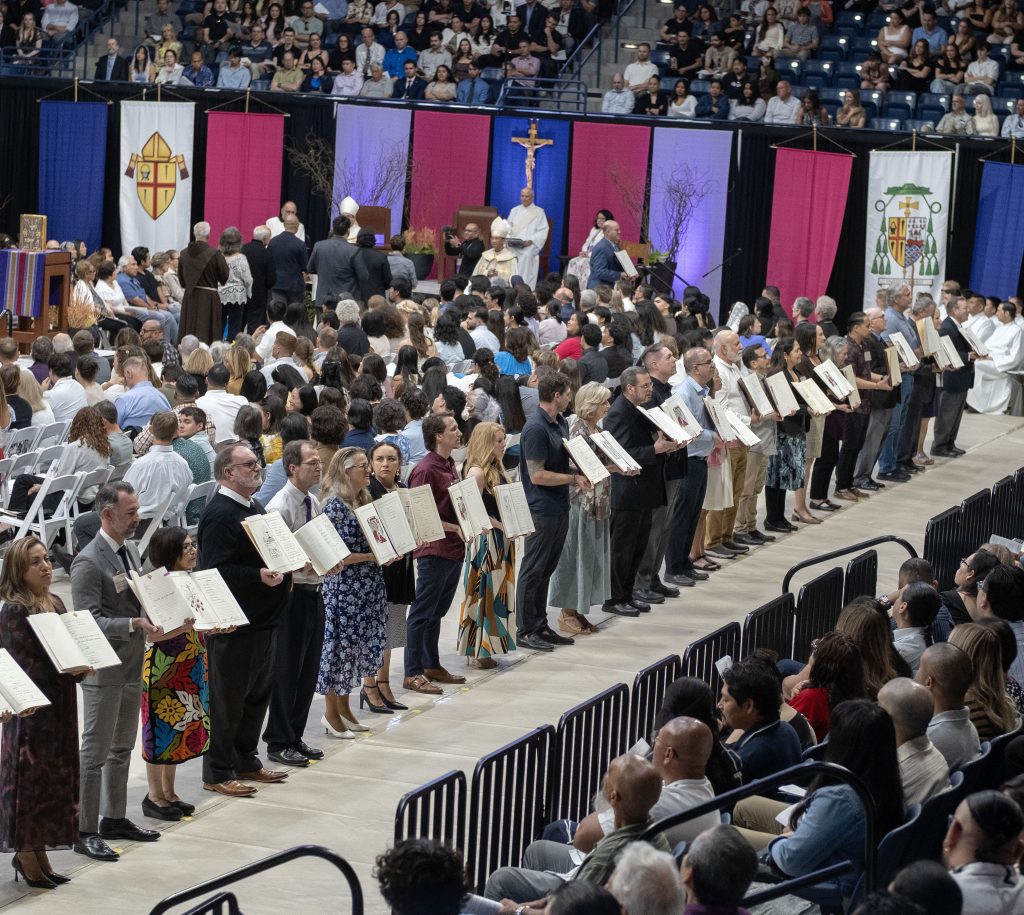
You could experience the Spirit at work as parishioners, ministry leaders, clergy and more came joyously together over two days to reflect on the new culture flourishing in the diocese — and to celebrate.
The emerging culture is rooted in synodality, a process that calls on all faithful to a deeper life of communion, participation and mission in the Church.
“There’s a lot of excitement about the ways a more participatory Church shares decision-making and responsibility for the direction parishes and the diocese are going,” said Dr. Maureen Day, Ph.D., a local theologian, sociologist, Church scholar, and member of the Diocesan Council for a Synodal Church.
“There’s just a lot of hope and energy that this could help revitalize our Church in the San Diego area.”
The diocese has been on a synodal journey for 10 years. It began in 2016 with a consultation of parishioners about how the Church could strengthen marriage and family life, under then Bishop Robert W. McElroy, who implemented the resulting recommendations of the Diocesan Synod on Embracing the Joy of Love.
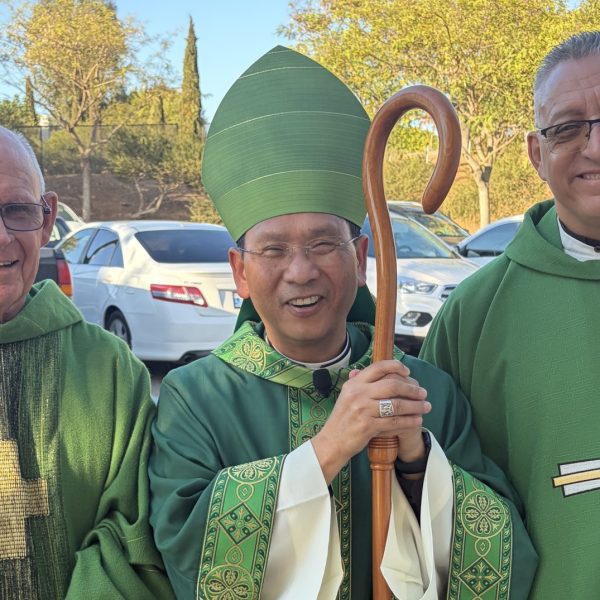
The journey continues under Bishop Michael Pham, who has made several organizational changes to encourage the growth of this culture across the diocese.
Dr. Day was among the 750 people or so who jammed into St. Gregory the Great Church in Scripps Ranch the night of Aug. 21 to listen to Sister Nathalie speak about re-imagining parish life in a synodal Church.
She’s uniquely positioned to do so serving as the Vatican’s Undersecretary of the General Secretariat of the Synod of Bishops. This department oversees the implementation of synodal practices around the world, allowing her “to contemplate the Spirit at work in every place and time.”
She began her talk by showing the logo the Vatican developed for the three-year Synod on Synodality, which ended in 2024. It shows a group of people walking together of different colors, ages and abilities, children, men, women and a bishop.
“But the main character is the Holy Spirit,” she told the audience.
In a synodal culture, everyone is encouraged to participate in Church life, listen to one another, and discern a path forward together.
“Not this superficial listening, but this deep listening, experiencing the presence of the Holy Spirit,” the sister continued.
“Do we believe that the Holy Spirit can speak through each of us, whatever our background, our age?” she asked. “In theory, yes, but in practice, most of the time, it’s not the case. Becoming a synodal parish is about becoming a Church in which we feel, we are, and we act as brothers and sisters in Christ with equal dignity.”
‘Vibrancy of our Church’
The day after her presentation, Sister Nathalie addressed the diocese’s third annual synod convocation, which drew nearly 400 coordinators, pastors and ministry leaders from the 44 parishes participating in the initiative “Re-Imagining Parish Life and Leadership in a Synodal Church.” Last year, a total of 36 parishes had participated, up from 16 at the inaugural gathering in 2024.
“This is what we are all about — journeying together, walking together, participating together and being on mission together as Church,” Bishop Pham told the convocation, held at St. Thomas More Parish in Oceanside. “It’s so wonderful to recognize that and see the vibrancy of our Church in our diocese.”
Before being named bishop, then Father Pham served as pastor of Good Shepherd Parish in Mira Mesa and vicar for the Office for Ethnic and Intercultural Communities. In those roles, he fostered a culture of listening and collaboration among the ministries and cultures.
He supported the consultations, or synods, the diocese held in the last decade among the faithful. They consisted of small-group dialogues at parishes, schools and ministries and an electronic survey.
On the day after he was installed as bishop of San Diego, July 17, 2025, he appointed Father Billy Zondler as Vicar for Synodality.
Father Zondler began having virtual meetings with all the “re-imagining” pastors and coordinators to promote collaboration. Then, he started meeting with them in person at quarterly deanery meetings, where they could share their experiences, build relationships and promote a synodal culture with the other pastors.
At the diocese itself, Bishop Pham has implemented a synodal approach at all levels, including directors’ meetings and committee gatherings. After a prayer, participants reflect, listen to one another in a dialogue, and discern together a path forward, guided by the Holy Spirit.
This year, Bishop Pham adopted new parish pastoral council guidelines in a synodal Church, which superseded the ones from 2006. Pastors are reviewing these guidelines with their councils for implementation.
And he established a Diocesan Council for a Synodal Church to formally assess the current state of synodal efforts and to share their experiences. The 23-member council is made up of synod leaders, lay representatives and pastors from across the region.
‘It is so powerful’
Vi Salazar is a member of the Council for a Synodal Church and the Women’s Advisory Committee, which was established in late 2023 to study the role of women in the diocese and make recommendations on how to increase opportunities for them to participate in the mission of the Church.
She was impressed with how Sister Nathalie had used a Scripture passage (John 21:3-6) to illustrate a synodal Church in action, what the sister called “going from ‘I’ to ‘we,’ together in mission.”
The Scripture passage describes Jesus, who has resurrected, appearing to his disciples while they are fishing. They tell him they have not caught any fish. He tells them to throw their net on the right side of their boat. When they follow his command, they catch an overwhelming number of fish, symbolizing that the disciples must follow Christ’s direction rather than their own to succeed in their mission.
“In the Gospel, fishing is an action undertaken together: Everybody has their own particular task, different but coordinated with the others,” the sister said at the Aug. 21 presentation. “This is the synodal Church in action.”
Salazar, a young adult ministry leader in the Vietnamese Catholic community, has been a member of diocesan councils since 2021, amid the COVID pandemic. These councils organized various consultations of the faithful, themselves utilizing synodal practices to discern their plans.
Salazar reflected on her own synodal journey since then.
Growing up in the Vietnamese culture, she said, “You could not really share anything about faith.
“We didn’t really get to ask like, ‘How do you feel?’ ‘What’s your hope for the Church?’ ‘Is there anything we can do to improve?’ None of that. So, when we started this process, I honestly did not know where it would go.”
Some four years later, she’s amazed at the impact the new approach is having.
At her own parish, Good Shepherd, “they are doing something based on our feedback.” She sees the same occurring at the diocesan level.
“Wow! It is so powerful that our voice is truly heard.”
As a young leader and a woman, Salazar said that she never imagined that the diocese would create a women’s leadership group.
“To be able to sit at a table with so many wonderful women from around our diocese is something that’s so inspiring to me. I have learned a lot along the way.”
‘Opening people’s hearts’
Teresa Moya, the synod co-coordinator at Sacred Heart Parish in Brawley, attended the convocation. Her parish has participated in the re-imagining initiative for three years. She said she was moved by Sister Nathalie’s message about synodal spirituality.
Moya said that when people hear the word “synodality” the first thing that comes to mind is change. “And many of us like our routines, we don’t like change.”
Sister Nathalie gave the word a more profound meaning: “a path that the Church is leading us to, of walking together.”
“She told us that it was an authentic way to be in communion with God and with those around you, with your neighbors,” Moya said.
She said she has been surprised how the Holy Spirit has been working in her parish, which is made up of three church communities that historically have resisted working together.
“I have been surprised how the Holy Spirit has been opening people’s hearts, inspiring them to feel an openness and confidence to believe that God is moving us, even though we don’t have a complete vision yet of where we’re going.”
Her parish began the synodal process under Father Bernardo Lara. As of July 1, he’s been assigned to serve as pastor of Our Lady of Angels Parish in San Diego. He has decided that his new parish should participate in the synodal initiative, as well.
“First of all, to foster a culture of listening,” he said.
Then he spoke about the need to address entrenched practices that have strayed from the Church’s theology and spirituality.
A group faithful from his new parish attended the convocation. He’s confident the experience with the synodal process “also will be transformative.”
“As it happened last time, I have no idea where we will go,” Father Lara said. “I know we have work to do. We will let God guide us.”
‘Path to peace’
Sister Nathalie said that a synodal approach can transform more than parish communities, it can change the world itself at a time marked by conflicts, divisions, polarization and wars.
“We understand, more and more, why it’s important to engage in the path of synodality,” she said. “It’s not just to be a nice Church among us, it is because it’s really a path to peace.”
And that path can be undertaken by families, communities, countries and more.
“Perhaps without speaking too much of synodality,” she continued, “peace can be achieved through the processes of listening, dialogue and reconciliation. Synodality is not just another ecclesial program. It is the grammar of peace that the Church proposes to the world by first living it within herself.”