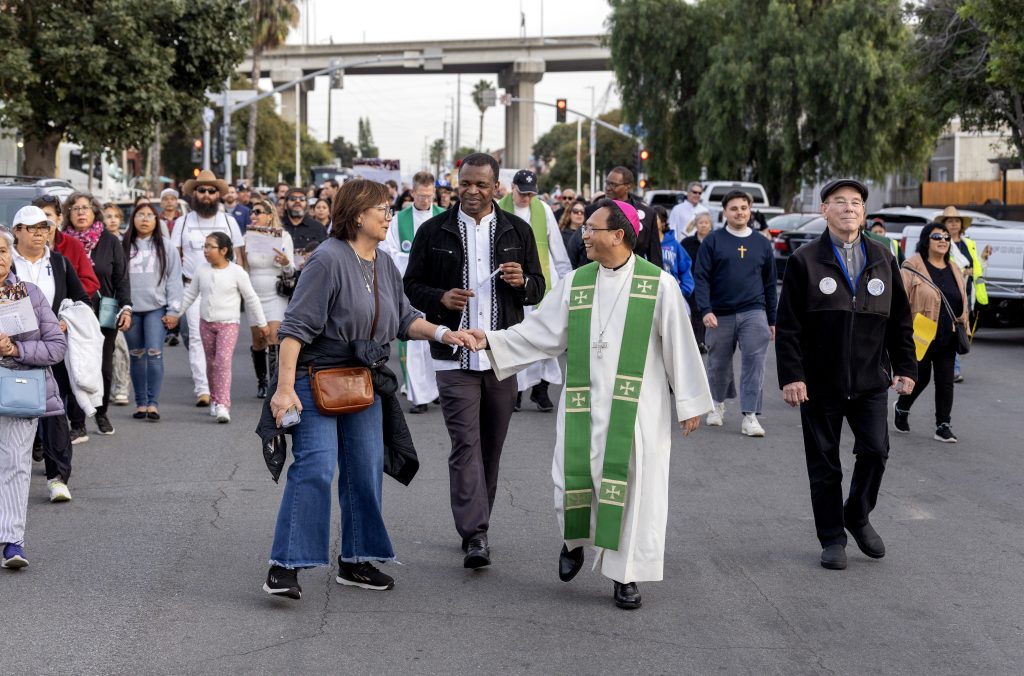
SAN DIEGO — The Rite of Election and Call to Continuing Conversion underwent a major change this year at Bishop Michael Pham’s insistence. This year, it was held on March 1, in the Jenny Craig Pavilion at the University of San Diego.
The annual diocesan liturgy is where those enrolled in the Order of Christian Initiation of Adults (OCIA) process are presented to the bishop and declared ready to receive the sacraments of initiation at the Easter Vigil.
This was the first time since the COVID-19 pandemic that the Rite of Election was held as a single ceremony, attended by catechumens and candidates from all participating parishes. In preceding years, the diocese had held multiple ceremonies, rather than one massive gathering.
The change fittingly reflected Bishop Pham’s episcopal motto, “United in Christ.”
More than 4,670 people attended the Rite of Election, including 611 adult catechumens; 1,242 adult candidates; and 102 child catechumens and candidates from 76 local Catholic communities.
Trent noted that unity has been a hallmark of Bishop Pham’s leadership.
She cited the annual Pentecost Mass for All Peoples, a multilingual liturgy followed by a cultural food fair. First held in 2018, it was the brainchild of then-Father Pham, when he was Vicar for Ethnic and Cultural Communities. Nearly 2,000 people attended its most recent iteration on May 23.
“Ever since the first celebration, the Pentecost Mass has remained a joyful, faith-filled occasion,” said Trent. “The celebration embodies the Body of Christ in the Diocese of San Diego, where diverse cultures, languages, food and music thrive under the Holy Spirit, showcasing the richness of our communities.
“This is where true evangelization happens,” she added. “We see the Holy Spirit at work.”
The bishop’s emphasis on unity, as well as his promotion of synodal listening, could also be observed in another highlight of the past year: OECM’s push to make Masses and faith formation more accessible to families with special needs.
“We have seen and heard the need of families having a place where they can come and really be themselves and receive the sacraments,” said Trent, who noted that some families with special needs have felt unwelcome at the typical parish Mass.
For some of these families, she said, packed pews, loud music, incense and other elements can be barriers to participation.
“In a synodal Church, we listen,” said Trent. “We see, and we listen, and then we adapt.”
The office held two workshops — one in English on July 26, 2025, at St. Mary Magdalene Parish, the other in Spanish on April 25, 2026, at Holy Trinity Parish in El Cajon – that provided practical tips for adapting liturgies and formation programs for this demographic. A “sensory-friendly Mass,” so called because it featured accommodations for worshippers with special needs, was celebrated after each workshop.
Those Masses, Trent said, enabled Catholics with special needs to be involved “not just as an attendee, spectator,” but as an active participant and to take on liturgical roles like lector.
“The goal of our office is to promote more of these events, more of these Masses throughout our diocese,” she said, describing the ones that have already been held as “a great achievement,” but promising “more to come.”