SAN DIEGO — Lent is an approximately 40-day liturgical season focused on penance and spiritual preparation for Easter.
When does it begin and end?
Lent begins on Ash Wednesday, which will be celebrated on Feb. 18 this year, and continues until the Evening Mass of the Lord’s Supper, which is celebrated on Holy Thursday (April 2 this year).
The Paschal Triduum, which begins with the Mass of the Lord’s Supper, continues with Good Friday of the Lord’s Passion (April 3) and the Easter Vigil on Holy Saturday (April 4), and it concludes at Evening Prayer on Easter Sunday (April 5).
Despite being a very popular day to attend Mass, Ash Wednesday is not a holy day of obligation. Neither are Holy Thursday, Good Friday and Holy Saturday; however, the Paschal Triduum is considered to be the high point of the liturgical year. To fulfill the obligation for Easter, one can attend any of the Masses that Sunday or the previous evening’s Easter Vigil.
Does Lent seem early this year?
Easter is celebrated on the first Sunday following the full moon that occurs on or after the spring equinox. It can be as early as March 22 or as late as April 25. That means that Lent can begin any time between Feb. 4 and March 10.
What does the word “Lent” mean?
In English, we call this season “Lent,” which is the Old English word for “spring.” Other languages, including Latin, use a different name derived from that language’s word for 40. For example, in Spanish, the season is called “Cuaresma”; “cuarenta” means 40.
What are Catholics expected to do during Lent?
The three pillars of Lent are fasting, abstinence from meat, and almsgiving.
What are the rules for fasting and abstinence?
According to the website of the U.S. Conference of Catholic Bishops (USCCB), “Ash Wednesday and Good Friday are obligatory days of fasting and abstinence for Catholics. In addition, Fridays during Lent are obligatory days of abstinence.”
On fast days, Catholics ages 18 to 59 may only eat “one full meal, as well as two smaller meals that together are not equal to a full meal.” There is to be no snacking throughout the day.
On days of abstinence, all Catholics age 14 and older must abstain from meat.
Though there is no obligation to do so, it is recommended that the fast on Good Friday be continued until the Easter Vigil the following evening.
Is fasting and abstinence only required during Lent?
Many Catholics mistakenly believe that not eating meat on Fridays year-round is something that went out after the Second Vatican Council.
But the Code of Canon Law states, “The penitential days and times in the universal Church are every Friday of the whole year and the season of Lent” (Can. 1250) and that abstinence “is to be observed on all Fridays, unless a solemnity should fall on a Friday” (Can. 1251).
The Solemnity of St. Joseph, Spouse of the Virgin Mary (March 19), sometimes falls on a Lenten Friday, which removes the requirement to abstain. It recently did so in 2021 and will do so again next year.
In their “Pastoral Statement on Penance and Abstinence,” issued in 1966, the U.S. bishops permitted Catholics in the United States to substitute a penance of their own choosing on non-Lenten Fridays in place of abstaining from meat, while still encouraging abstinence.
What other devotions or practices are recommended during Lent?
In addition to fasting and abstinence, Catholics are encouraged to make voluntary acts of self-denial, such as “giving up” a favorite food or hobby for the duration of Lent.
Considering its focus on repentance, Lent is also a perfect time to go to confession, especially if it’s been a while. Catholics are obligated to receive the Eucharist at least once a year during the Easter season, a requirement known as one’s “Easter duty”; if a Catholic is conscious of having committed a mortal sin, they cannot fulfill their duty without first receiving sacramental absolution.
The Stations of the Cross is also a popular devotion during Lent, with most parishes scheduling it on every Lenten Friday and on Good Friday itself. The devotion allows the faithful to follow Jesus through 14 individual scenes of his Passion, spanning from the moment he was condemned to death by Pontius Pilate to when his dead body was laid in the tomb.
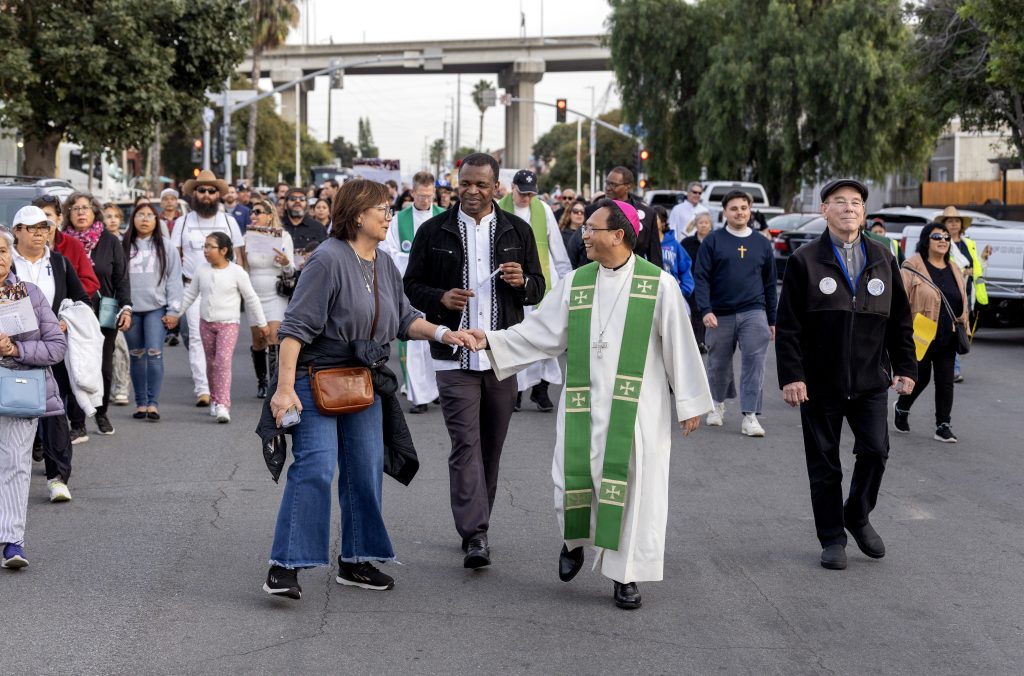
Catholics in San Diego County also have the option of attending two outdoor presentations of the Stations of the Cross, which are held every year on Good Friday in downtown San Diego. These will include the 33rd annual Walk with the Suffering, which seeks to connect Jesus’ passion with contemporary causes of suffering in the local community, and the 21st annual Good Friday Pro-Life Stations of the Cross, which reflects on the unborn lives lost to abortion.
Why do we receive ashes on our foreheads on Ash Wednesday?
The ashes, which are blessed with holy water and traced in the shape of cross on the foreheads of the faithful, are a reminder of our mortality. They also recall how putting on sackcloth and ashes, as referenced in the Bible, was a way of demonstrating one’s repentance.
Fittingly, the two formulas that can be used when administering ashes are “Remember that you are dust, and to dust you shall return” and “Repent and believe in the Gospel.”
What’s with the purple and pink?
If you think back to Advent, the four-week liturgical season that serves as a time of preparation for Christmas, you will recall that priests and deacons wore purple liturgical vestments. Purple is the color of penitential seasons.
An exception was the Third Sunday of Advent, called “Gaudete Sunday” (Latin for “rejoice”), when rose-colored vestments were worn.
Something similar occurs in Lent, which sees a return of purple vestments after the white vestments worn during the Christmas season and the green ones during Ordinary Time. Rose vestments will make a comeback on the Fourth Sunday of Lent, “Laetare Sunday” (from another Latin word for “rejoice”), which represents an occasion to “rejoice” that Lent is halfway through.