SAN DIEGO — Imagine what it would be like to sleep on the cold cement, maybe with just a piece of cardboard underneath you. Now imagine that you’re a senior citizen, struggling to survive on the streets while suffering with chronic ailments.
That’s the reality for a growing number of older adults, the fastest-growing segment of the unsheltered population in San Diego County. Data released by the Regional Task Force on Homelessness showed that people aged 55 and older accounted for 33% of the unsheltered population this year, compared to 29% last year. More than 40% of the seniors were experiencing homelessness for the first time in their lives, driven by soaring rents and other living costs.
For decades, Catholic Charities, Diocese of San Diego, has worked tirelessly and compassionately to give homeless women and men a safe respite from the streets, and offered a variety of resources to help them to get back on their feet.
This service is a part of a broader commitment by the organization to ensure that vulnerable senior citizens across San Diego and Imperial counties are not forgotten. This effort includes a senior nutrition program, senior residential services and a Foster Grandparents initiative that pairs seniors with at-risk students.
The organization operates the Rachel’s Women’s Center, a drop-in day facility located in downtown San Diego to help homeless women. The center extends a warm welcome, offers food and basic services and connects the women with public, non-profit and community resources.
The staff does more than that, however.
“It’s a place of hope and encouragement during difficult times,” said the CEO of Catholic Charities, Appaswamy “Vino” Pajanor, during a public event June 10 at the center.
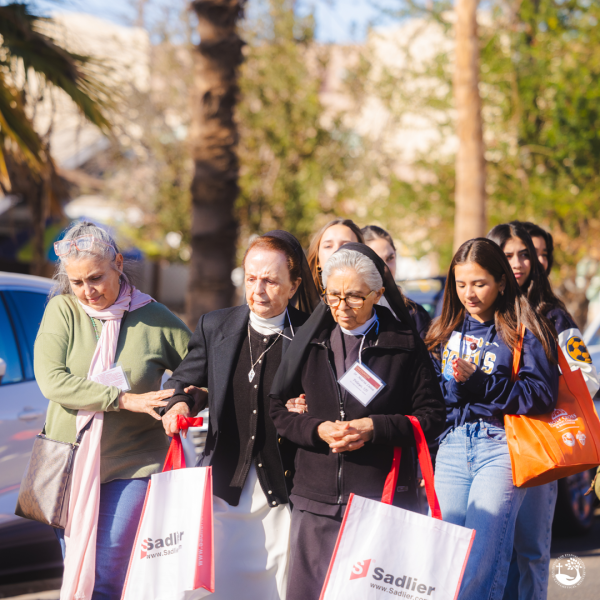
The event, called AEC Cares, gathered volunteers from around the country to remodel and refresh the 42-year-old facility in an intensive day of donated work and materials.
Catholic Charities also operates Rachel’s Night Shelter, a 35-bed, short-term emergency shelter for unhoused women, and Rachel’s Promise, a 50-bed shelter for women, both located downtown. The latter is to expand this summer to 210 beds and will serve women and children.
Taken together, the three facilities have served around 4,000 women from 2019 to early June of this year. Of those, around 21% were 55 to 64 years old, and nearly 10% were age 65 and older.
The County of San Diego’s Behavioral Health Services funds Rachel’s Women’s Center, and the San Diego Housing Commission funds Rachel’s Promise.
‘Trauma on Top of Trauma’
Antoinette Fallon is the director of Homeless Services for Catholic Charities, where she has worked for 17 years.
“Think about how unsafe it feels to be sleeping on the sidewalk,” she said. “People get their stuff stolen, they get kicked while they’re sleeping, women wake up and there’s a man on top of them. Trauma on top of trauma.”
In fact, around 60% of the organization’s unhoused clients self-reported that they had been the victims of trauma, such as domestic violence and sexual assault. The director believes the number is much higher.
“In my experience, every single person who walks through our doors… has a history of trauma,” Fallon said.
She stressed that everything the center does is designed to avoid re-traumatizing the women.
Around two-thirds of the women reported that they suffered from a mental health problem, including substance abuse, she said. And 41% reported they had chronic health conditions.
Working with the County of San Diego, the center connects the women to a mental health clinic, healthcare personnel and other experts to address their problems.
The staff links older adults with organizations that specialize in helping seniors, including to find housing.
‘Your Next-Door Neighbor’
The center is open from 7 a.m. to 5 p.m. every day of the year, including holidays. The women come and go throughout the day, totaling between 80 to 85 in recent days.
The staff serves coffee and a continental breakfast in the morning, and a hot lunch at midday. “For some people who are unhoused, that may be the only hot meal they get all day,” the director said.
After the remodeling project, the women can now enter through a bright, expanded reception area, enjoy new furnishings, and use updated bathrooms and showers.
The staff members offer the women services to address the barriers that prevent them from being housed permanently. They connect them with recovery programs, health screenings, housing navigation and an employment specialist, all coordinated by a case manager.
The women can take showers, get emergency clothing, or simply hang out and talk to one another, all away from the harsh realities of the street.
Over the years, Fallon has encountered countless women in crisis. What stands out to her?
“I look at them and I realize I could be one of them,” she said. “There is absolutely no difference between the people we serve and us. They are somebody’s mother, somebody’s sister, somebody’s daughter.”
She recalled a woman who suffered with a major depressive disorder, and was chronically suicidal.
“She was a soccer mom from Scripps Ranch.”
Clients have included laid-off teachers, nurses, and women who had been living for years a stable life until their husbands or partners died, leaving them without the means to support themselves.
“These women really are your next-door neighbor.”
‘Taking Care of Me’
Ruby Griffin lived alone in Chicago after her husband of 60 years died in 2021. She wanted to live close to her daughter and her two grandchildren, who live in San Diego. So, last April, she boarded a train in her hometown and headed west.
As soon as she landed, Griffin, 79, made her way to the San Diego Rescue Mission to ask for help to find housing she could afford. The staff immediately took her to the Rachel’s Promise shelter.
There, the staff arranged a bed for her and for meals and other basic services nearby at Rachel’s Women’s Center, all coordinated by a case manager. They helped her to apply for apartments.
On a recent Tuesday morning, Griffin reflected on the help she was receiving at the shelter — and couldn’t stop smiling.
“They are taking care of me so I can save my money so that I can get a place to live,” she said. “I feel like I can live into my 80s knowing that there’s a place here that can take care of me.”
She paused for a moment, then continued.
“I lost my joy when my husband passed away. Catholic Charities has given me my joy back.”
How You Can Help
Catholic Charities’ programs for the homeless seek:
–Financial donations, which may be made online at ccdsd.org.
–Donated items such as new underwear, socks, hygiene products, liquid laundry soap, coffee, creamer, individually wrapped snacks (granola bars, muffins, cheese cracker packets, etc.), paper products (paper towels and toilet paper), and hand and dish soap. They can fill out an in-kind donation form at ccdsd.org to coordinate drop-off.
–Volunteers to do simple tasks, such as sorting donations, filing, etc. They can email volunteer@ccdsd.org to get started.
Information: For any service, email info@ccdsd.org.