SAN DIEGO — “Our religious traditions may express this truth in different ways, but today people of many faiths stand together to affirm a common conviction… All are sacred.”
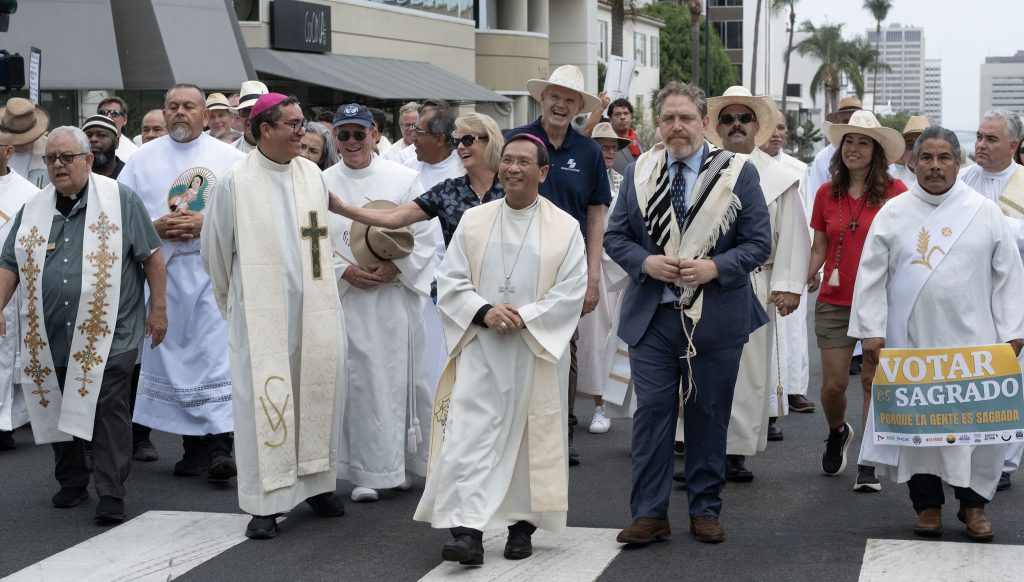
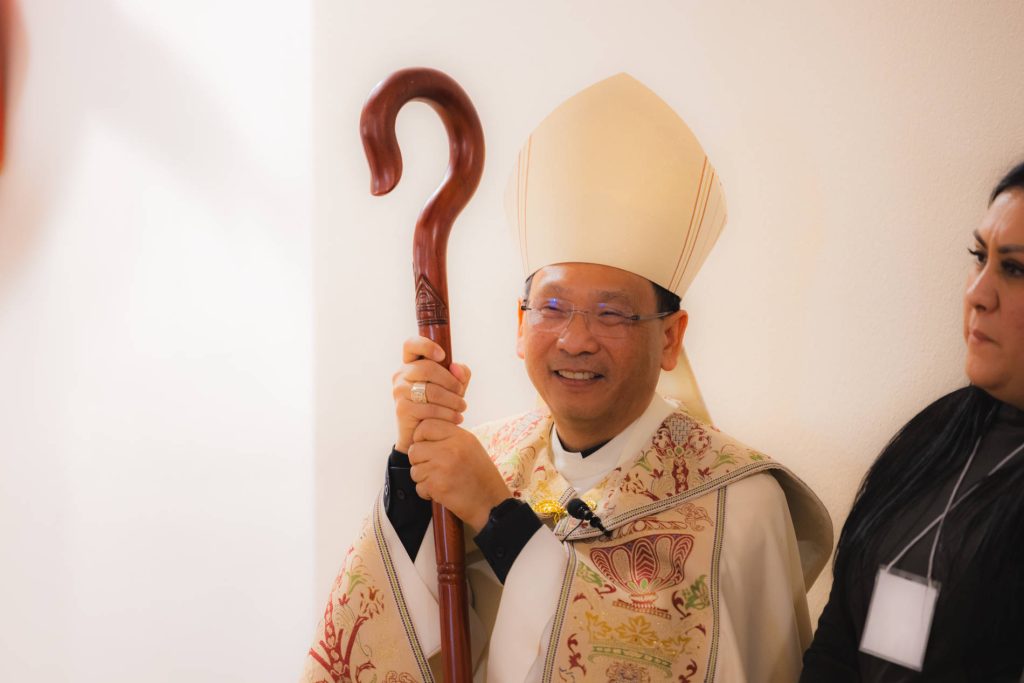
That’s what Bishop Michael Pham proclaimed moments before he and the leaders of several faith traditions led a procession of more than 4,000 people around Balboa Park on humid, at times rainy Sunday afternoon, to support immigrants.
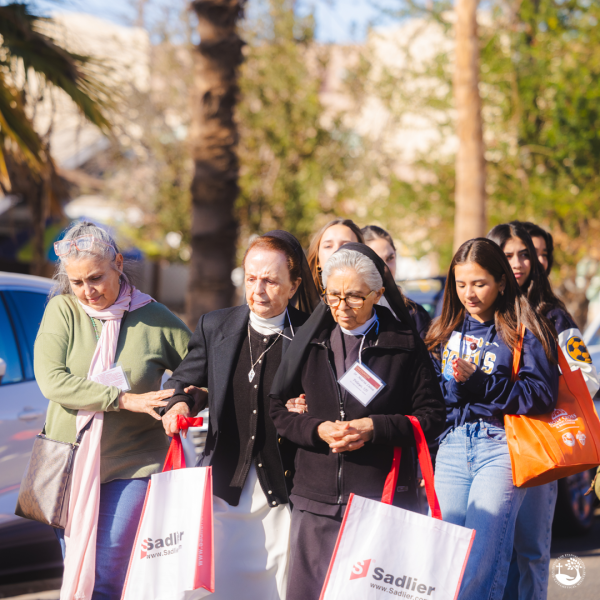
They had turned out on World Day for Immigrants and Refugees on Sept. 27, along with the leaders from Christian, Jewish and Muslim faith traditions. Bishop Pham and Auxiliary Bishop Felipe Pulido, of the Catholic Diocese of San Diego, participated, as did dozens of priests and deacons, and faithful from at least 33 parishes, some arriving on 14 buses from across the region.
The procession was a partnership among the diocese, the San Diego Organizing Project and Our Lady of Guadalupe Parish (Barrio Logan) and supported by a labor union and community organizations.
The procession came amid the massive deportation campaign the federal government is waging.
Bishop Pham invited faith leaders to meet in mid-August to explore how they could come together to respond to the crisis in their communities. They decided to publicly proclaim their support for immigrants in an interreligious procession called “All Are Sacred,” envisioned as an annual event going forward.
Eight faith leaders addressed the participants before the 1.1-mile-long procession, a multi-ethnic, multi-generational throng. Each spoke about how migration shaped their faith and called them to act at this pivotal moment in the nation’s history.
“We believe in the inherent worth and dignity of every person,” said the Rev. Justine Sullivan, from the First Unitarian Universalist Church. “Each of us contains within us a spark of the divine … My little spark and each individual’s little spark may not shine that brightly. But when we join together and raise our voices in song and march for justice, then our light shines brightly for all to see.”
Then came Imam Taha Hassane, of the Islamic Center of San Diego.
“Throughout history, migration has often been part of the faith journey, borne of deep hardship, displacement and persecution,” he began. “When people are forced to flee their homeland, they leave behind homes, livelihoods and memories. They arrive not merely seeking shelter, but seeking dignity, safety and a hand of brotherhood.
“At that point, it becomes a duty for us, as people of faith and goodwill, to protect them, to welcome them, and to advocate for their wellbeing and dignity.”
Rabbi Mike Rothbaum, of the Dor Hadash congregation, also spoke about how migration had shaped his faith.
“The foundation story of the Jewish people is the story of Israelite immigrants whose devotion and labor were repaid by pharaohs with bondage and brutality,” he began. “Out of that fiery furnace, those refugees received a Torah that teaches no less than 36 times to love and respect and honor the immigrant because we know as Jews what it was like to be immigrants in Egypt, in Europe, and today.”
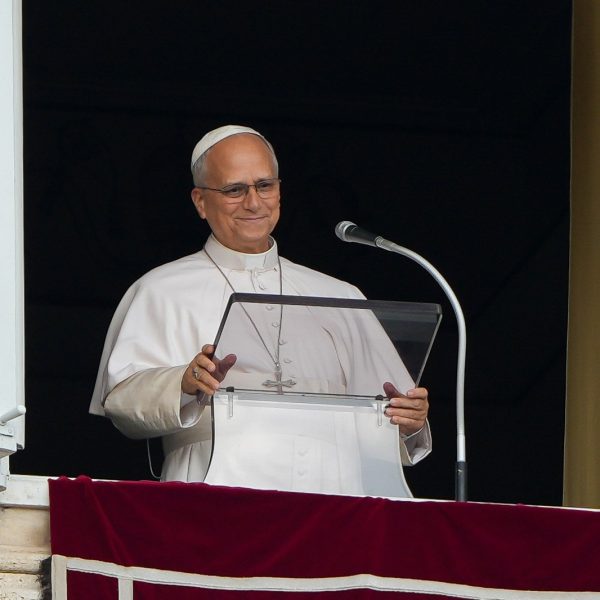
For his part, Bishop Pham began his remarks by recalling the theme that Pope Leo XIV had selected for this year’s World Day of Immigrants and Refugees, “Even just one of these children.”
“Those words remind us that, before there are questions of politics or policy, before there are arguments about borders and immigration, there is a human person before us,” he said. “No matter where we were born, no matter where we now live, no matter what language we speak, and no matter what our immigration status may be, we are all sacred.”
“The nation has the right to regulate its borders and to establish laws governing immigration, he said, “but how we enforce those laws is a moral and ethical issue. We cannot uphold the law by setting aside human dignity. We cannot allow fear to convince us that some human beings matter less than others.
“Today, people of many faiths stand together to affirm a common conviction: Human dignity is not something a government gives us. It is not something earned by citizenship. It does not depend upon the documents we carry. It belongs to us because we are human beings. For Christians, we say even more: ‘Every person is created in the image of God, the image and likeness of God.’”
Bishop Pham, like the other leaders, urged action, individually and collectively.
“When human beings are frightened, faith must speak. When a family faces separation, faith must speak. When people are treated primarily as problems rather than as persons, faith must speak. And our voice must not be a voice of hatred or condemnation. It must be a voice of conscience, a voice of compassion, a voice of justice, a voice that reminds our nation of its deepest values and reminds each of us of our responsibility to one another.”
The bishop highlighted the power of moving forward.
“Walking requires us to move … And perhaps that is also what our country needs from us now. We need to move beyond fear, beyond labels, beyond the divisions that tell us we must view one another as enemies. … Our walk cannot end when this procession ends. Tomorrow, we must continue walking with one another in our churches, synagogues, mosques and temples.
“We must continue walking with one another in our schools, in our workplaces, in our neighborhoods, and especially with those who are afraid to walk alone. … We must speak when human dignity is threatened, and we must work together for immigration policies and practices that are just, humane and worthy of the dignity of every human person.
“All are sacred.”