SAN DIEGO — Presence has enormous power.
Power to make someone feel human. Power to bear witness. Power to bring God’s warm love into a cold courthouse.
The ministry that accompanies undocumented immigrants to their hearings and ICE check-ins at the downtown federal courthouse marks its first year in August.
In that time, clergy members and volunteers have prayed with countless migrants, comforted family members whose loved ones were detained, and raised awareness to what is unfolding daily as the federal government wages a massive deportation campaign.
In 2024, Immigration and Customs Enforcement (ICE) agents detained around 600 undocumented immigrants in the San Diego-Imperial Valley region. In 2025, they detained 8,300, according to The San Diego Union-Tribune.
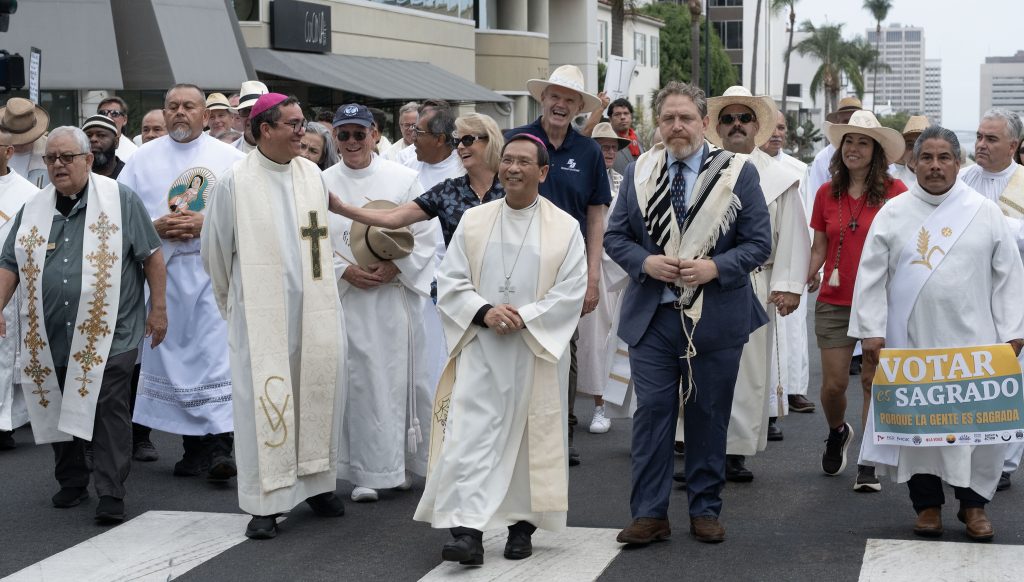
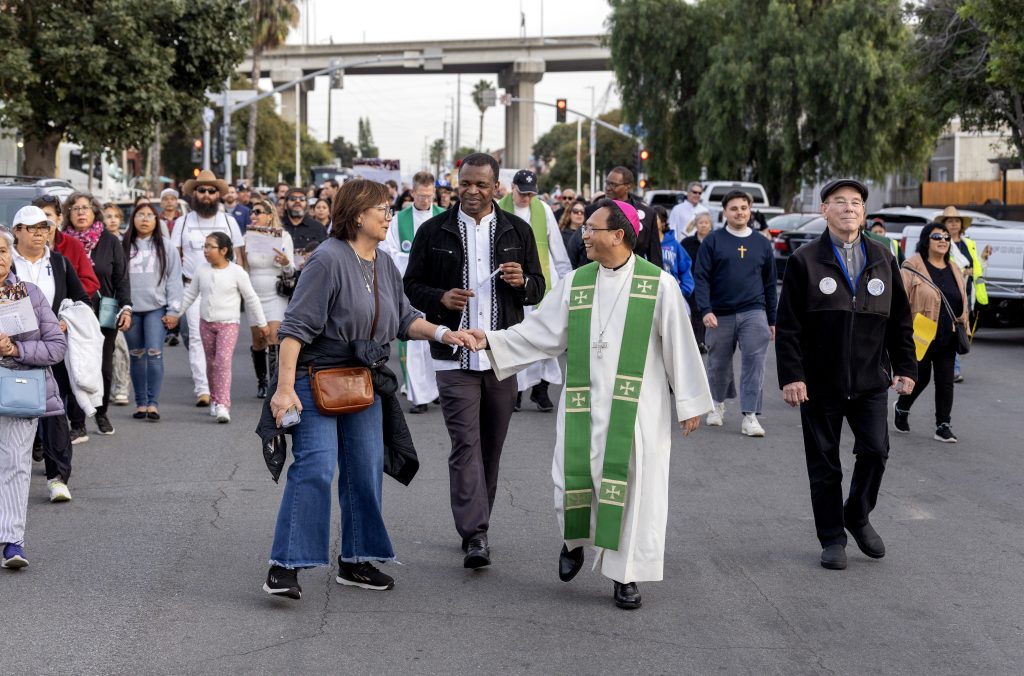
The ministry, known as FAITH (Faithful Accompaniment in Trust and Hope), is a collaborative effort of the Catholic Diocese of San Diego, under the leadership of Bishop Michael Pham; Our Lady of Guadalupe Parish in Barrio Logan; and the San Diego Organizing Project.
‘Traumatic and awful’
A total of 713 people have received training to serve as FAITH volunteers, 162 of them members of the clergy, as of July 14. They include 51 Catholic priests, 24 deacons and 13 religious women. Clergy from other faith traditions also are participating, as are individuals who are not affiliated with any faith, according to Jesuit Father Scott Santarosa, of Our Lady of Guadalupe Parish.
Small groups of volunteers, around 5 to 7, meet weekdays outside of the courthouse three times a day to serve in two-hour shifts, starting at 7:30 a.m., 10 a.m. and 12:30 p.m. They share information, pray together and then head inside.
“We pray for those that we hope to serve, and for the people who work in the building,” said Deacon Chris Hulburt, a regular volunteer since the ministry began. “We’re not there to protest. We’re there to bring the body of Christ to what’s happening there.”
He said what the volunteers are doing “is the essential ministry of the Church, which is to accompany the least of these, to accompany the outsider, to care for the oppressed, to defend the defenseless, to speak for the voiceless. This is the core of who we’re called to be as Christians.”
At times, migrants request accompaniment. The volunteers meet them outside of the building, pray with them and walk in with them and their family members.
The action occurs mainly on two floors. The second floor houses the ICE office and another one, known as ISAP (Intensive Supervision Appearance Program). The courtrooms where the hearings are heard are located on the fourth floor, which has a waiting area.
The volunteers head to the fourth floor, which is open to the public, where they can sit at the back of the courtroom, being present for the migrants facing the judge and praying. They can approach migrants in the hallways and in the waiting area, introduce themselves, offer information about community resources and offer to pray with them.
Holding a rosary, Deacon Hulburt said he tries “to make loving eye contact, try to detect an openness.”
“I wish I could speak all languages, but I don’t,” he said. “But we can speak the language of love, of presence and peace. And we can do that in a lot of ways that have nothing to do with words.”
The migrants are from all over the world, not just Latin America. They come from Russia, Ukraine, Azerbaijan, Haiti, China and Nigeria, among other countries.
Father Santarosa said the situation inside the building has evolved in the last year, viewing distinct phases as chapters.
“The first chapter was very bleak,” he said, of the period last summer when the ministry began.
Deacon Hulburt recalls that period well.
“The horrific thing was that immigrants would have a hearing in a courtroom with the judge, make arrangements to come back another day or even have their case dismissed.
“And then, they would walk out and be surrounded by heavily armed, disguised, intensely intimidating ICE agents, and be swept away. It was really traumatic, awful and terrifying.”
He said the volunteers were “present for all of that, praying with family members who were left behind, stunned, praying with those who were being detained. Even many of the ICE agents shared with us that they didn’t approve of what they were asked to do.”
Chapter 2 began in late fall, Father Santarosa said. ICE agents would arrest the migrants on the second floor, a restricted area not open to the public.
Father Santarosa attributes the change to the presence of the volunteers.
“It was more scandalous to do it out in the open where all of us could see it,” he said, “and now easier to do it somehow behind closed doors.”
In Chapter 3, instead of necessarily arresting migrants, the agents were putting a surveillance device on then, such as an ankle bracelet, to keep tabs on them, he said.
The current chapter involves “mass dockets,” when as many as 100 migrants are summoned to court on a given day, often on short notice. The people who do not show up are issued an automatic order to be detained and deported.
How the authorities have responded to the volunteers has changed over time, as well.
“ICE agents were getting very frustrated with our presence in the hallways,” Deacon Hulburt recalled. “Some took it upon themselves to try to intimidate and harass the FAITH ministers, telling us that we couldn’t be there.”
As a result, the ministry leadership, including Bishop Pham, met on May 8 with the leaders of the Federal Protective Service, which is responsible for the security at the courthouse, Father Santarosa said. The leaders explained what they were doing and why. The agency affirmed that volunteers had the right to be in the public areas, he said.
“That gave us a renewed sense of confidence of being in that space,” said the deacon, who was present at the meeting. “But that did not always change the attitude of ICE agents. Some of them still have great disdain for our presence, and sometimes they want to kind of intimidate us out of their environment.”
‘Incredibly emotional’
Fidel is an undocumented immigrant from Mexico. He and his wife have been members of Christ the King Parish for 27 years. They have two U.S.-born daughters, ages 20 and 26.
Living in the U.S. since 1996, Fidel said in a recent interview that he has never been convicted of a crime.
Immigration authorities ordered Fidel to appear in court on Oct. 9. His family requested FAITH volunteers accompany him to his hearing.
Auxiliary Bishop Felipe Pulido; Father Tommie Jennings and Deacon Carlos Morales, both from his parish; and several parishioners, agreed to accompany him.
“When I was asked to accompany Fidel, I immediately said ‘yes,’” Bishop Pulido said. “His story and his family’s faith have left a lasting impression on me.”
At the hearing, the judge continued Fidel’s case until January.
“As we stepped out of the courtroom and into the hallway, an ICE agent approached us and asked, ‘Who is Fidel? I have a message for him,’” the bishop recalled.
Fidel’s attorney explained that he had just received a new court date. The agent replied that Fidel needed to report to the second floor for what he described as a routine check-in.
Once on the second floor, only the attorney was permitted to go into the ICE office with Fidel.
About 10 minutes later, the attorney emerged with heartbreaking news: “They are taking everyone.”
Moments later, they watched ICE agents rush Fidel to the elevator to take him to a holding cell in the building’s basement.
His two daughters began to cry. A volunteer, who knew the family well, tried to comfort them.
The group walked outside, where Fidel’s wife was waiting.
“It was an incredibly emotional reunion,” the bishop recalled. “Everyone embraced one another, and despite her own pain, the wife said with remarkable faith, ‘Let us not lose hope. God is with us, and he will help us through this difficult journey.’”
‘We felt human’
In the interview, Fidel described the harsh conditions in the cell.
“There were 20 of us crammed into a small room,” he recalled. “We slept sitting up, and received cold, sometimes spoiled food to eat. It was very ugly in there.”’
After four days, he was transferred to the Otay Mesa Detention Center, where he spent the next six weeks, until his release on Nov. 24.
The parish community rallied around the family, helping to raise funds for his defense.
As the immigration case against him proceeded, the volunteers have continued to accompany him to his court hearings, held in April and May.
The volunteers’ impact was profound.
“We felt that we were important to someone,” Fidel said. “When we saw our Church and other people supporting us, we felt like human beings.”
He continued, “I felt that I was not alone, that God was always with me.”
His youngest daughter suffers from severe depression, worsened by his immigration crisis, he said. His attorney is pursuing a special visa to allow Fidel to stay in the country to take care of her. If he does not receive it by October, his ability to pursue the visa will end, and he will be forced to voluntarily return to Mexico or be deported.
‘The greatest gift’
Chris Gomez has been a weekly volunteer since the ministry began a year ago.
A retiree, she said the experience “hasn’t always been easy.”
At times, her back would hurt from standing around. Facing armed, masked men “was scary.” Then there was the trauma playing out in front of her.
She recalled seeing an old man being taken away in front of his children and grandchildren, who began to sob. Another time a man pleaded with the volunteers — “Help me, call my family!” — as agents led him away.
The volunteers compared notes among one another and were able to track down the family, she said.
Gomez said she feels the gratitude of migrants she passes in the hallways, who thank her for being present.
Like the other volunteers interviewed, she said the ministry has changed her in several ways. The biggest change has been “finding joy in the sorrow.”
“I think the joy for me has been just being there because I feel if Jesus were here, physically, I think he would be there, too.”
Father Santarosa said that the volunteers are people who are used to getting results, but in this ministry, they can’t do that. “We can’t change outcomes or prevent arrests.”
“This has been humbling for us,” he said.
Bishop Pulido said the FAITH ministry underscores the power of accompaniment.
“Accompanying Fidel and his family reminded me that ministry is not about having all the answers,” he said. “Sometimes, the greatest gift we can offer is simply our presence, our prayers, and the assurance that no one has to face suffering alone.”