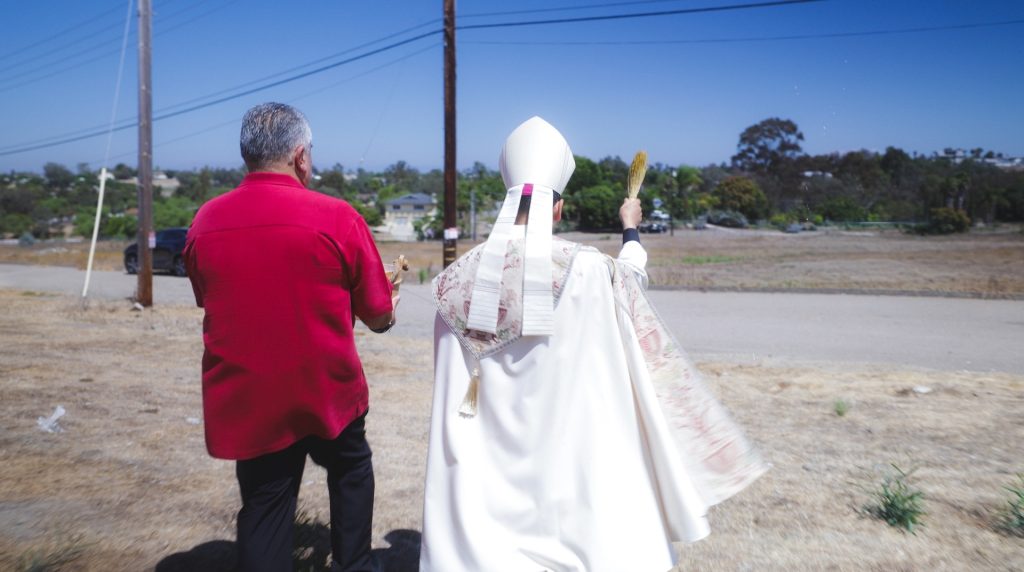
SAN DIEGO — On Oct. 27, 1986, St. John Paul II convened the World Day of Prayer for Peace in Assisi, Italy. For the first time in history, representatives of all world religions were invited to pray together for peace.
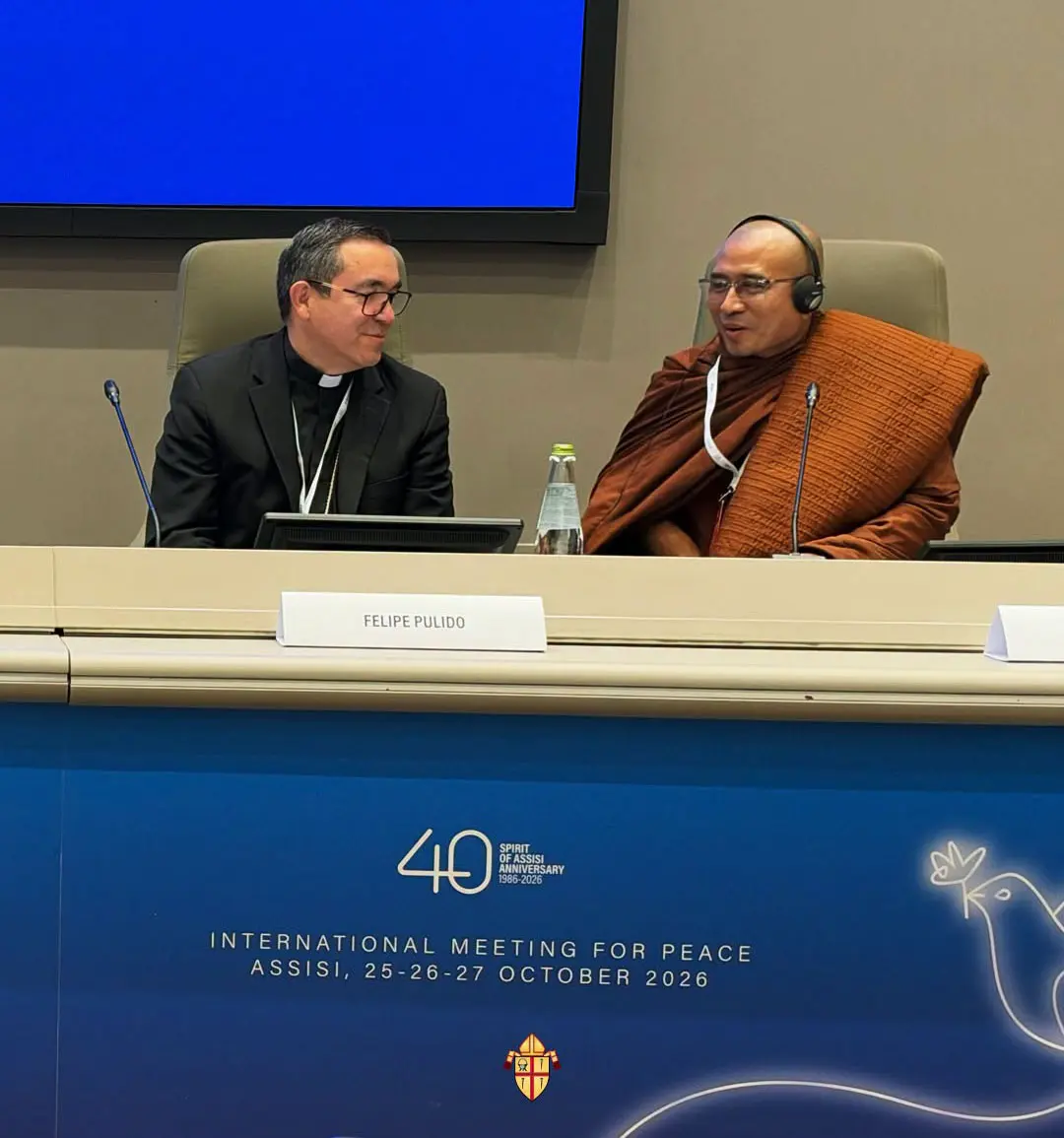
Forty years later, the leaders of all the worlds faiths gathered once more at Assisi, including Bishop Michael Pham and Auxiliary Bishop Felipe Pulido, of the Catholic Diocese of San Diego, and Bishop Mark Seitz, from El Paso, the only U.S. bishops invited to address what has grown over the years to be a world conference on peace.
Nearly 400 representatives of religions, cultures and institutions from 53 countries attended the annual gathering, Oct. 25 to 27. It was organized by the Community of Sant’Egidio, an international lay Catholic association and non-profit organization dedicated to prayer and service to the poor.
The 155 speakers explored a variety of perspectives in 24 forums. The conference theme was “Unarmed and Disarming Peace,” inspired by Pope Leo’s theme for the World Day of Peace, which the Church will observe on Jan. 1. He had planned to attend the gathering on the final day but delivered his message through a video instead, since he was recuperating from lung surgery.
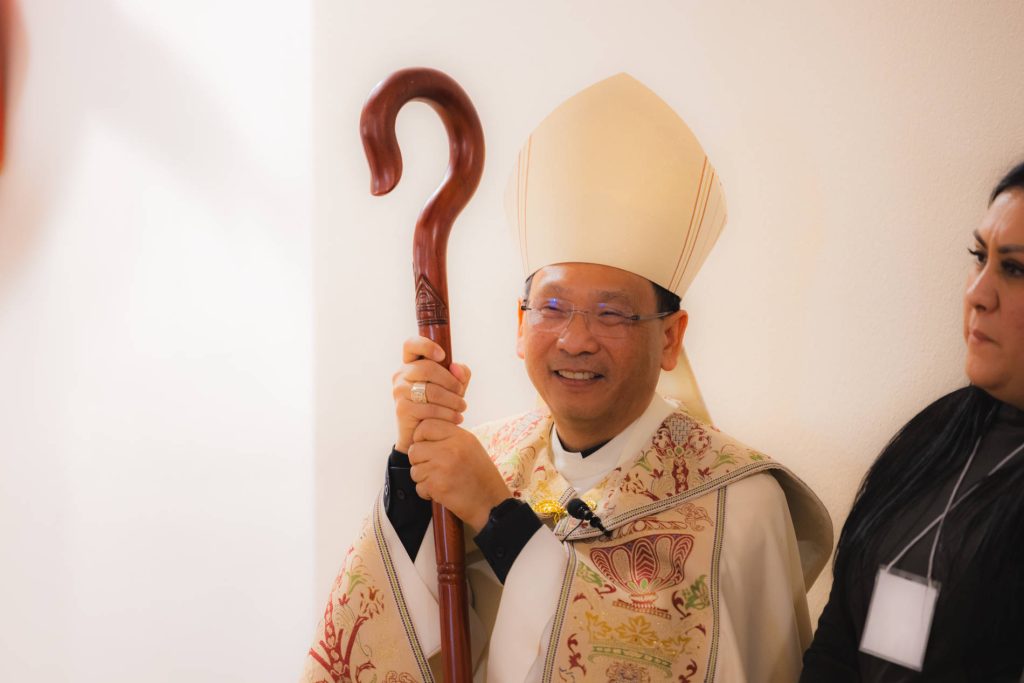
In their respective forums, Bishops Pham and Pulido touched on their personal histories and shared a glimpse of life in San Diego.
Bishop Pham addressed a forum titled “People Come Before Borders” on Oct. 26, while Bishop Pulido addressed “The Poor: A Source of Humanity” the following day.
“Migration is not an abstract issue for me,” began Bishop Pham, who fled Vietnam with two siblings when he was a child. “I have been the migrant. I have been the refugee. I have been the stranger.
“And now I am a pastor who looks into the faces of migrants and immigrant families who are searching for security, freedom, and hope.”
He spoke about how the immigration issue is testing democracy in the United States.
“The American democratic tradition begins with a remarkable claim: that human beings are created equal and endowed by their Creator with rights that are not simply gifts of the government…
“America has never lived those ideals perfectly. No democracy does. But the strength of a democracy is not that it has never failed. Its strength is that it possesses principles by which it can examine itself, correct itself, and ask again whether its exercise of power is faithful to the dignity and freedom it professes.”
In the United States today, immigration enforcement and mass deportation have become sources of profound division and fear, he said.
The bishops of the United States have “opposed the indiscriminate mass deportation” of people, while also praying for an end to dehumanizing rhetoric and violence directed at both immigrants and at law enforcement, he said.
“In my own diocese, I meet documented and undocumented immigrants. I hear from families who fear separation. I hear from people who are afraid to go to work, take their children to school, seek help, or sometimes even come to church.
“These are not simply political categories. They are our neighbors. They work beside us. Their children go to school with our children. They worship beside us.
“So, I ask: Can we protect a border without losing sight of the person standing at it? Can we uphold law while also protecting human dignity and due process? Can we disagree about immigration policy without turning migrants — or those charged with enforcing the law — into enemies?
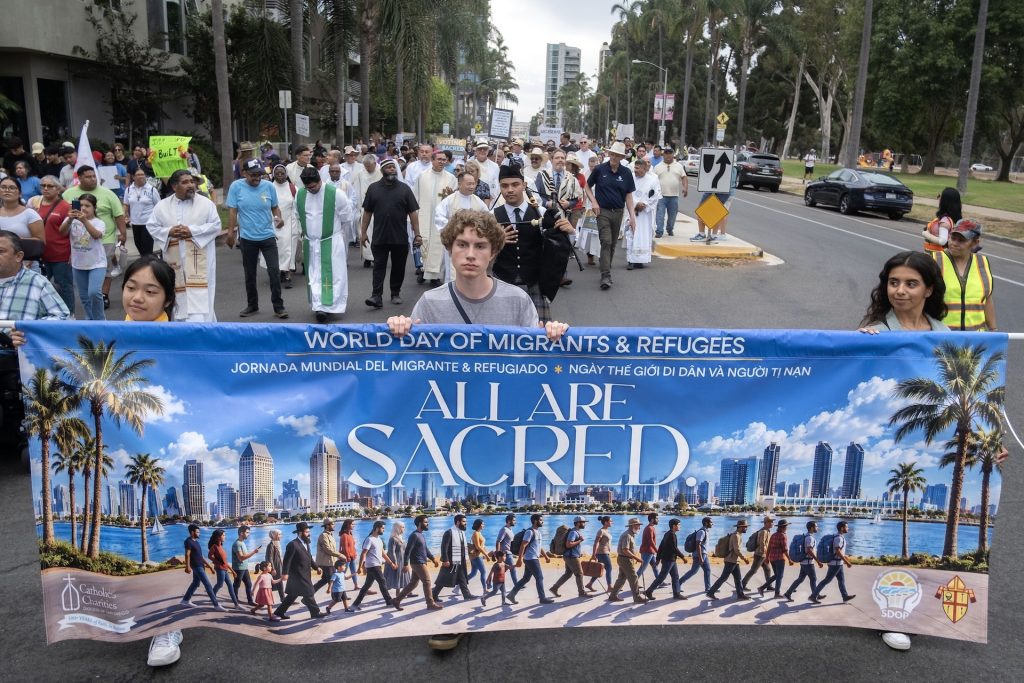
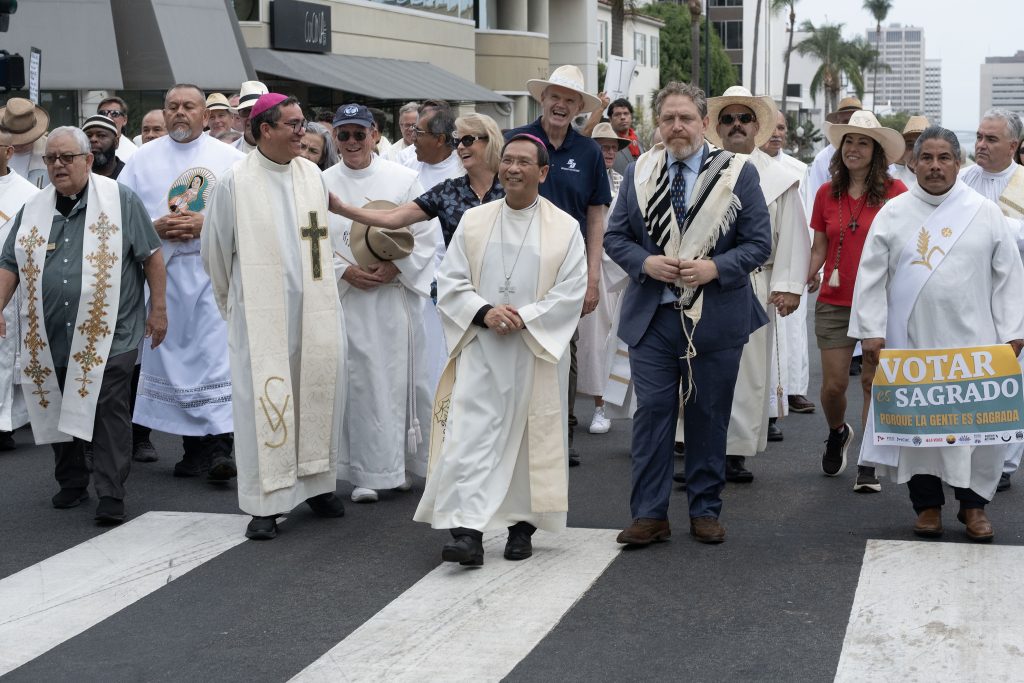
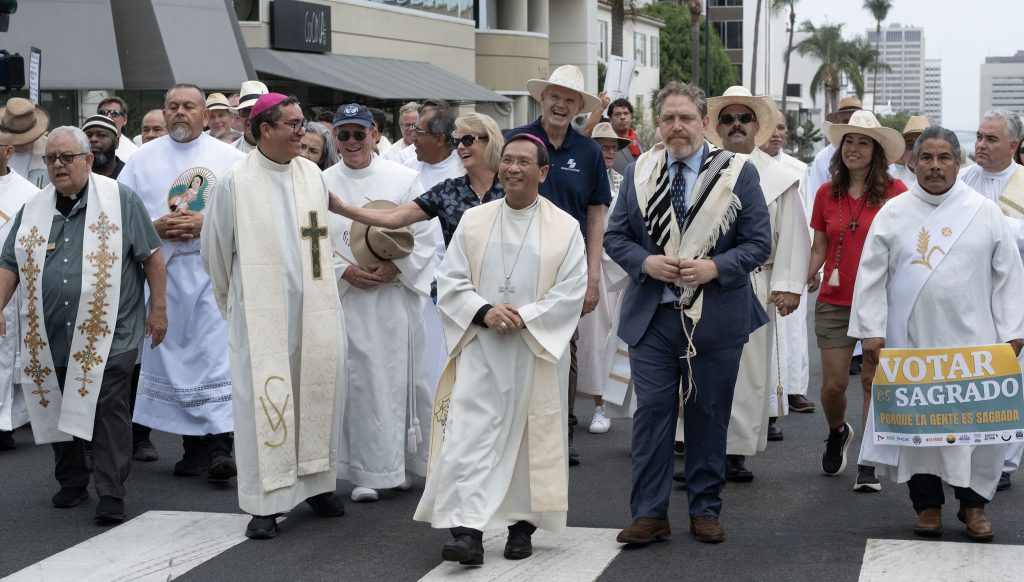
Then he shared that thousands of people had gathered for the World Day of Migrants and Refugees on Sept. 27 in San Diego, including more than 50 faith leaders from different religions and cultures, all walking peacefully in a procession of faith and solidarity.
“They found a rhythm together, chanting: ‘All are sacred! All are sacred!’”
“For a moment, people who did not share the same religion, culture, language, nationality or political views found a common voice.
“It was a glimpse of what can happen when we begin to disarm ourselves — when we put aside, even for a moment, the labels and fears that divide us and recognize the human person walking beside us.”
Then he referred to the conference theme, “Unarmed and Disarming Peace.”
“Certainly, our world needs to be disarmed of weapons. But perhaps our societies also need to be disarmed of fear.
“Our language must be disarmed when it turns human beings into categories or enemies. Our politics must be disarmed when disagreement makes us incapable of seeing one another. And our hearts must be disarmed when fear becomes stronger than compassion.
“Perhaps migration puts this question before every democracy and before every religious community: Can we exercise responsibility without surrendering compassion? Can we protect the common good without forgetting the sacredness of the person? Can we allow memory, encounter and dialogue to disarm the fear that makes strangers into enemies?
“Forty years after the first gathering here in Assisi, perhaps the Spirit of Assisi still asks us to find that common rhythm — not by erasing our differences, but by refusing to let our differences destroy our recognition of one another …. To remember. To encounter. To recognize the sacred human person before us.
“Perhaps this is how we become a disarmed people. And perhaps this is where peace begins.”
For his part, Auxiliary Bishop Pulido addressed a forum about how the poor are a source of humanity.
“For many people, poverty is a problem to be solved. For others, the poor are people who do not have a lot of resources or people who live day by day. Moreover, for others, the people are a problem they would rather not see,” he began.
“But the Gospel invites us to look again. Perhaps the poor are not simply a problem for humanity to solve. Perhaps the poor reveal to us what it means to be human. The Scripture reminds us of this from beginning to end.”
He told that gathering that the topic of poverty was personal for him.
“I grew up into a poor family in central Mexico. I am the oldest of seven children. My dad was the only one working at the time in the family, and the money was not enough. For me, poverty is personal because one day my dad made the decision to cross the border into the United States of America so that we could have a better future. And we came with him.
“In the United States of America, we encountered good people who gave us a hand, who helped us get jobs and opportunities to succeed, for which I’m very grateful. We encountered people who welcomed us, protected us, promoted us into the communities where we live, and that made all the difference.”
He said that when Jesus says that the poor you will always have with you, “we realize that these are not simple words from the past. They are words spoken to us today.”
Then he reflected on three ways in which the poor are a source of humanity.
“The poor remind us that life is not about us,” he summarized at the end. “The poor can become a source of our salvation because they give us the opportunity to encounter Christ. St. Francis Assisi teaches that when we free ourselves from our attachment to possessions and place ourselves in God’s providence, we can discover something the world cannot buy. True freedom, true fraternity, and true joy.
“Perhaps the poor do not simply need us. Perhaps in the mysterious providence of God, we need the poor to remind us who we are, who our neighbor is, and who Christ is.
“The poor are not simply the margins of humanity,” he concluded. “They can help us to rediscover our humanity, and in discovering our humanity, we may discover Christ.”