SAN DIEGO — “This has been so very enlightening.”
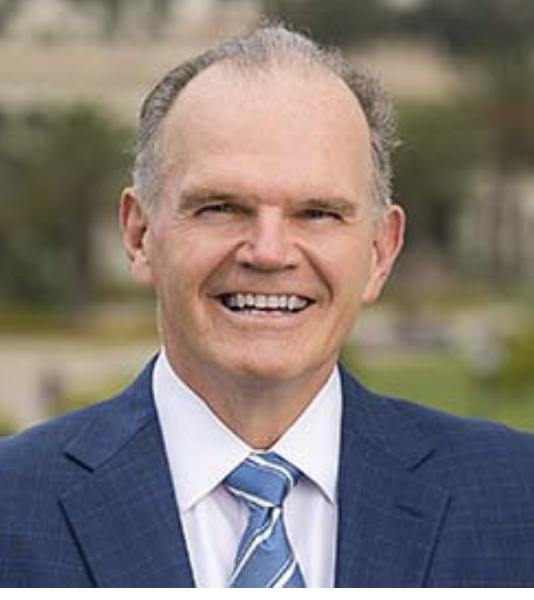
That’s what Father Brent Kruger, CSC, told the audience at the conclusion of an evening focused on anti-Semitism and other forms of hatred, as well as the role that interfaith dialogue can play in opposing these evils.
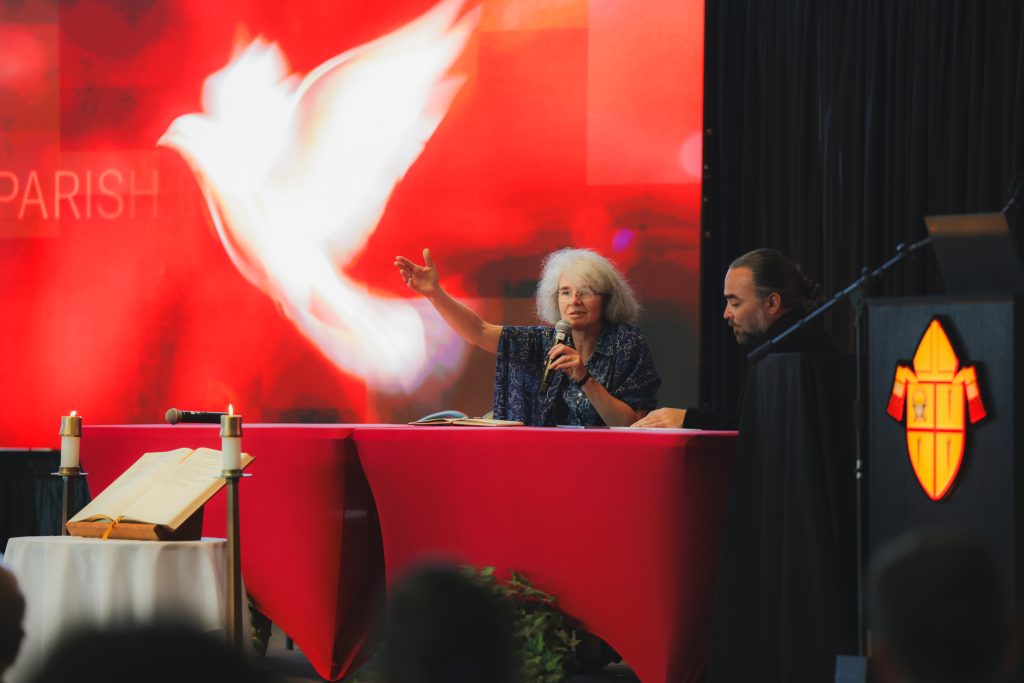
The event, titled “Confronting Extremism: Oren Segal in Conversation with Father Brent Kruger,” was held Sept. 9 at St. Thérèse of Carmel Parish, where Father Kruger serves as pastor.
Co-hosted by ADL San Diego and St. Thérèse of Carmel Parish, it featured a moderated, on-stage conversation between Segal, who serves as senior vice president of counter-extremism and intelligence for the Anti-Defamation League (ADL), and Father Kruger, who has served since July as diocesan vicar for ecumenical and interreligious affairs. A Q&A session followed.
To an audience that included Auxiliary Bishop Felipe Pulido, diocesan Chancellor Marioly Galván, and San Diego County District Attorney Summer Stephan, Father Kruger said, “All the background work that I have had to do on anti-Semitism and on extremism (to prepare for the event) has really made me grow and understand things in a new way, and appreciate my Jewish brothers and sisters’ struggle in the world, and know that we are not as different as the world would make us out to be.”
ADL San Diego Regional Director Fabienne Perlov, who moderated the event, reminded participants of the timeliness of the evening’s topic. She noted shootings at the Islamic Center of San Diego in May of this year, at Annunciation Catholic Church and School in Minneapolis in August of 2025, and at the Chabad of Poway synagogue in late April of 2019.
Father Kruger began the conversation by sharing that he had moved to the Diocese of San Diego in the aftermath of the shooting at Chabad of Poway and was assigned as associate pastor of St. Michael Parish in Poway, which is located only about 2.5 miles away from it.
He recalled that St. Michael Parish, like other houses of worship, was “very nervous and very concerned” about the potential for a copycat attack. To allay those fears and keep the faithful safe, some of the parish’s hospitality ministers, who were licensed to carry concealed weapons, would face the doors throughout the entire liturgy.
“I remember being so impressed … how that community actually came together in such a scared moment to act as a support to each other,” Father Kruger said.
He later shared that, in response to the tragedy at Annunciation Catholic Church in Minneapolis, steps were taken locally to improve security at Notre Dame Academy, the school adjoining St. Thérèse of Carmel Parish. And there was “a lot of pushback initially from parents” over the inconvenience of having to sign in to see their own child or to attend school Masses with them.
Segal said that reaction reflects a “common dilemma” experienced by many in the Jewish community.
“We want to have a welcoming community that invites people in during high holidays or other times,” he said, “and yet, we have to have … security guards and a security apparatus around every one of our institutions.”
“How do you balance that?” he asked rhetorically. “How do you make people feel, ‘Oh, I want to go to that place that has armed guards in front of it’? … It’s a challenge.”
During the on-stage conversation, Segal offered insights about the nature of hate as he has encountered it in his work.
He acknowledged that “it seems like things are getting worse …; that hate is more common; that hate, in a sense, is a form of entertainment.”
Segal shared that there are “a host of (online) platforms in which young children are spending an inordinate amount of time basically celebrating the concept of violence for what it is” and that “mass shooters from the past … are actually venerated as saints in these online spaces.”
But, drawing from his firsthand experience on the frontlines of identifying threats, successfully bringing them to the attention of law enforcement and engaging with social media platforms to reduce online hate, Segal offered some cause for hope.
“You need to know that there are people who you will never meet, who spend every single day (working) to minimize the impact of that hatred,” he said, “and the successes actually outweigh, I think, some of the places of fear that we find ourselves in.”
“I see the impact of fighting hate every single day,” he said.
Reflecting on the nature of extremism, Segal said that “it’s very rare to find somebody who purely hates any one community,” even if they choose to unleash violence only on a specific group. He noted that, in their manifestos, mass shooters reveal hatred of cultural and religious groups other than the one targeted.
“That’s a call to all of us to recognize that the problem of another community, at the end of the day, is all of our problem,” Segal said.
He told his audience that technology, including social media and AI, can be “a tool that will help us defeat this hatred or a tool that can be used against us to make it worse.” He encouraged attendees to report the experiences that they and their children have with encountering hate online.
“My argument is that no AI platform should be teaching people how to commit a mass casualty attack. … I think holding platforms, including social media, accountable is the other thing that we can do to push back against that,” he said.
He said that some social media platforms “actually care, believe it or not,” but acknowledged that other companies “couldn’t care less” and that “hatred is actually the selling point,” how they attract and grow their audience.
“Yes, hate and extremism is good for some of these companies’ bottom line,” he admitted, “and so, what we need to do is find creative solutions on how to force them to make that change. They’re not going to do it on their values, so what are our legal opportunities?”
Segal offered some clarity on what anti-Semitism means.
Noting that he is an Israeli, he said that merely criticizing the state of Israel is not, in and of itself, anti-Semitic. Just as many U.S. citizens criticize their government, he said, not all Israelis are supporters of everything their political leaders do.
Where it “crosses the line into anti-Semitism,” he said, is when anti-Israel rhetoric “cast(s) aspersions on the entire Jewish community.”
“If you want to protest Israel, that’s completely protected … I may disagree with you, (but) it’s not inherently problematic,” he said. “If you want to protest Israel in front of a synagogue, that’s a problem, because you’re ascribing blame to an entire religious community for the actions of a state.”