SAN DIEGO — The Solemnity of the Assumption of the Blessed Virgin Mary is on Saturday, Aug. 15.
What does it commemorate?
It celebrates the fact that Mary, at the end of her earthly life, was taken up (or, assumed) — both body and soul — into Heaven.
Is it a holy day of obligation?
Not this year, at least not in the United States.
The Code of Canon Law includes it as one of 10 holy days of obligation that, like every Sunday of the year, “must be observed” (Canon 1244). However, it notes that, with approval of the Holy See, national bishops conferences can suppress some holy days of obligation or transfer them to a Sunday.
The U.S. Conference of Catholic Bishops issued a decree, which went into effect in 1993, that the obligation to attend Mass for the Solemnity of the Assumption is dispensed when it falls on a Saturday (like this year) or a Monday.
What’s the difference between “assumption” and “ascension”?
Jesus, who was fully God as well as fully human, “ascended” to Heaven by his own divine power as God. Mary, who is only human, was entirely dependent on God to “assume” her body and soul into Heaven.
Must Catholics believe in the Assumption?
Yes. The dogma of the Assumption of Mary was infallibly defined by Pope Pius XII on Nov. 1, 1950, in the apostolic constitution “Munificentissimus Deus.” In it, he wrote, “By the authority of our Lord Jesus Christ, of the Blessed Apostles Peter and Paul, and by our own authority, we pronounce, declare, and define it to be a divinely revealed dogma: that the Immaculate Mother of God, the ever Virgin Mary, having completed the course of her earthly life, was assumed body and soul into heavenly glory.”
Does this mean that the Church didn’t believe in Mary’s Assumption before 1950?
No, that’s not how papal infallibility works. “Munificentissimus Deus” even cites the First Vatican Council’s teaching on papal infallibility, that “the Holy Spirit was not promised to the successors of Peter in such a way that, by his revelation, they might manifest new doctrine, but so that, by his assistance, they might guard as sacred and might faithfully propose the revelation delivered through the apostles, or the deposit of faith” (Paragraph 12).
Catholic apologist Tim Staples, in a 2019 article for “Catholic Answers,” wrote that the Church’s teaching regarding the Assumption “began with a historical event … that (has) been believed in the Church for 2,000 years. It was passed down in the oral tradition of the Church and developed over the centuries, but it was always believed by the Catholic faithful.”
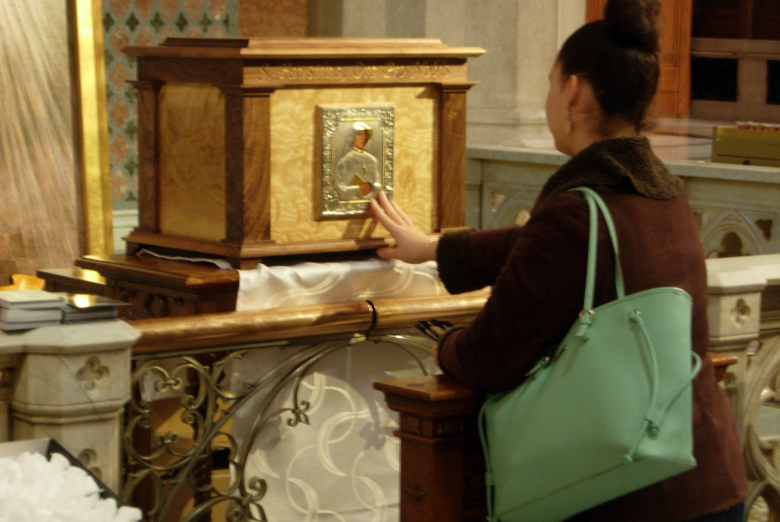
He noted that, despite the Church’s tradition of venerating saints’ relics, there has never been a purported relic of Mary’s body. Two locations are claimed as her tomb, but neither contains bodily remains.
“As revered as Mary was, (having no one claim to have relics of her body) would be very strange,” said Staples, “except for the fact of the assumption of her body.”
The year 1950 wasn’t that long ago. Are there recordings of the proclamation of the dogma?
A contemporary British Pathé news report can be viewed on YouTube. The brief video is under two minutes long. To find it, search for “The Assumption Proclamation (1950).”
Is Mary the only person to be bodily assumed into Heaven?
Based on Scripture, many believe that the prophet Elijah, who “went up to heaven in a whirlwind” (2 Kings 2:11), and Enoch, of whom Scripture says he “walked with God, and he was no longer here, for God took him” (Gen 5:24), were similarly assumed.
How frequently do Catholics reflect on the Assumption?
The Assumption is the fourth of the five Glorious Mysteries of the rosary, typically prayed on Wednesdays and Sundays. So, for Catholics who pray a daily rosary, the answer is: at least twice a week.
What does the Assumption mean for us?
When you and I die, our bodies and souls will be separated. The former will decompose in our graves, while the latter go to Heaven (either directly or after passing through Purgatory) or to Hell. Our bodies and souls will not be reunited until the end of time.
That’s not the case with Mary, and her example gives a glimpse of our future.
The Catechism of the Catholic Church says that Mary “already shares in the glory of her Son’s Resurrection, anticipating the resurrection of all members of his Body” (Paragraph 974).
“Munificentissimus Deus” (Paragraph 5) states that Mary, “by an entirely unique privilege, completely overcame sin by her Immaculate Conception, and as a result she was not subject to the law of remaining in the corruption of the grave, and she did not have to wait until the end of time for the redemption of her body.”
Pope Pius expressed hope “that belief in Mary’s bodily Assumption into heaven will make our belief in our own resurrection stronger and render it more effective” (Paragraph 42).
Are any local parishes named after the Assumption?
No, but St. Kateri Tekakwitha Parish in Lakeside is composed of three mission churches on three Indian reservations. One of them, located at Barona, is Assumption of the Blessed Virgin Mary.