SAN DIEGO — Aug. 14 is the feast day of St. Maximilian Kolbe.
It’s also the 85th anniversary of the day on which the Franciscan friar was martyred at Auschwitz, the infamous Nazi death camp, where he offered his life in exchange for that of a fellow prisoner who was a husband and father.
St. Maximilian was canonized on Oct. 10, 1982, by Pope St. John Paul II.
Deacon Bobby Ehnow, director of the diocesan Office for Life, Peace and Justice, has long had a devotion to St. Maximilian, whom he describes as “a spiritual ally” and, at times, affectionately refers to as simply “Max.”
“He has been a ‘go-to’ saint of mine since I was incarcerated in 2013,” he said, “and I continue to ask for his intercession to counsel and bless the ministry that I lead at the diocese.”
Recently returned from a visit to the saint’s native Poland, which included a tour of Auschwitz, Deacon Ehnow reflected on his relationship with St. Maximilian and what we can learn from his life and death.
It was in the summer of 2013 that Deacon Ehnow first encountered St. Maximilian. At the time, the future deacon was an inmate at a federal prison in Colorado and had barely begun the 27 and a half months that he would serve there for conspiracy to commit wire fraud and for bribery.
In the prison chapel, he stumbled across a documentary about St. Maximilian, which taught him that the martyr is a patron saint for prisoners and was a strong promoter of the rosary – at the time, a devotion that Deacon Ehnow had recently embraced.
Deacon Ehnow prayed the rosary on his first night in prison and continued to pray it for the entirety of his 807 days in custody. Early in his incarceration, he started a rosary group that, within six months, had grown to include about 20 inmates.
St. Maximilian made another appearance in Deacon Ehnow’s life shortly after he joined the diocesan staff, where his focus is primarily on restorative justice and prison ministry.
In the summer of 2018, about a month into the job, he was given an icon of St. Maximilian by a fellow diocesan employee who had taken up iconography. The gift inspired him to learn more about the saint’s life.
He said, “He’s been a real inspiration for me and … a spiritual ally because of the ministry that I’m working in.”
Deacon Ehnow recently attended and spoke at the 13th International Conference of the European Forum for Restorative Justice, which was held from June 11 to 13, at SWPS University in Poznań, Poland.
Before the conference, he paid a visit to Krakow, which included a day trip to the Auschwitz-Birkenau death camp on June 8. He described it as “the largest cemetery on the planet, where 1.1 million people were murdered and their remains incinerated in massive ovens and open fields.”
Among them was St. Maximilian, who was sent to Auschwitz in May of 1941. About two months later, the deputy camp commander ordered that 10 men be killed by starvation as a punishment for another prisoner’s successful escape. One of the men, Franciszek Gajowniczek, pleaded that he had a wife and children, and Father Kolbe volunteered to take his place.
Gajowniczek, a fellow Polish Catholic, would not only survive the war, but live to attend the beatification and canonization of St. Maximilian in 1971 and 1982, respectively. He died in 1995 at age 93.
In his recently published book, “All Things New: A Journey from Brokenness to Restoration,” Deacon Ehnow recounted the story of St. Maximilian’s martyrdom.
“In the starvation bunker, he led prayers, strengthening the other men,” the deacon wrote. “After two weeks, only four prisoners, including Father Kolbe, remained. The Nazis executed them by injecting carbolic acid into their veins.”
“Witnesses reported that Kolbe peacefully raised his arm in surrender. He died a martyr for his faith,” added Deacon Ehnow, who, during his visit to Auschwitz, saw Cell 18 in Block 11, where St. Maximilian died.
Deacon Ehnow told The Southern Cross that the Polish saint was “a man of not only deep faith, but also of courage,” and had demonstrated these virtues long before his final moments. Among his ministry assignments, St. Maximilian had run a Catholic publishing house and served as a missionary in China, Japan and India.
“Standing up for what’s right is a part of what we’re supposed to do as Christians,” Deacon Ehnow explained.
“We don’t talk about it all the time, but the ask is, to die for Christ,” he said, recalling Jesus’ exhortation: “I give you a new commandment: Love one another. As I have loved you, so you also should love one another” (John 13:34).
“Jesus literally died for us,” he said, “and he’s asking us to have the same kind of love for each other, which means sacrificial love to the point of death.”
More about Maximilian
San Diego is home to St. Maximilian Kolbe Roman Catholic Polish Mission, which is located at 1735 Grand Ave. in Pacific Beach. Masses, all celebrated in Polish, are celebrated at 7 p.m. on Fridays and at 9 and 11 a.m. on Sundays. Learn more at polishmission.org.
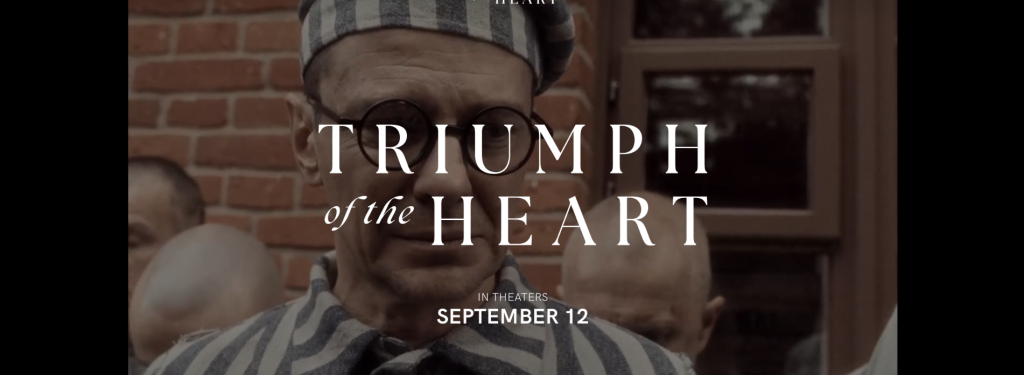
St. Maximilian’s martyrdom also was recently the subject of a dramatic film, “Triumph of the Heart,” which was released in 2025 and is now available on DVD and streaming. Learn more at triumphoftheheart.com.