SAN DIEGO — The month of May has traditionally been dedicated to Mary.
Who is Mary? Why is she special?
Mary is the mother of Jesus Christ, the Messiah and Son of God. A virgin, she conceived her Son miraculously through the power of the Holy Spirit.
To prepare her to become Jesus’ mother, Mary herself was conceived without Original Sin — this is the dogma of the Immaculate Conception, infallibly defined in 1854 by Pope Pius IX — and was completely sinless throughout her life.
When her life on earth was over, she was taken — body and soul — into Heaven, so that her body would never experience decay. This is the dogma of the Assumption, which was infallibly defined in 1950 by Pope Pius XII.
How long has May been Mary’s month?
The origins of this practice are believed to go back at least to the 13th century.
The Catholic Encyclopedia says that the present-day devotion can be traced back to the late 18th century, when a Jesuit priest at the Roman College of the Society of Jesus, seeking “to counteract infidelity and immorality among the students,” made a vow to devote the month of May to Mary.
The encyclopedia says, “From Rome, the practice spread to the other Jesuit colleges and thence to nearly every Catholic church of the Latin rite,” becoming “the oldest instance of a devotion extending over an entire month.”
What Marian devotions are unique to May?
Many parishes and schools hold “May Crowning” ceremonies, where Marian hymns are sung and a statue of the Blessed Mother is crowned with flowers. This is a recognition of Mary’s position as Queen of Heaven.
The Feast of the Queenship of Mary, when it was instituted by Pope Pius XII in 1954, was originally observed on May 31. However, Pope St. Paul VI transferred the feast to Aug. 22.
Does Mary have feast days in May?
May 13 is the Feast of Our Lady of Fatima, which commemorates a Vatican-approved Marian apparition to three shepherd children — Lucia dos Santos and her cousins, Francisco and Jacinta Marto — in Fatima, Portugal, in 1917.
May 31 is the Feast of the Visitation, which commemorates an incident recorded in Luke 1:39-56, in which Mary “set out and traveled to the hill country in haste” to visit her cousin, Elizabeth, who was already 6 months pregnant with St. John the Baptist at the time Jesus was conceived.
Do local Catholics have special reasons to honor Mary?
In the Canticle of Mary, also known as the Magnificat, Mary said, “(God) has looked upon his handmaid’s lowliness; behold, from now on will all ages call me blessed” (Luke 1:47-48). That prediction has proven true. But, if San Diegans in particular, need additional reasons to honor Mary, other than her being the Mother of God, here are a few more.
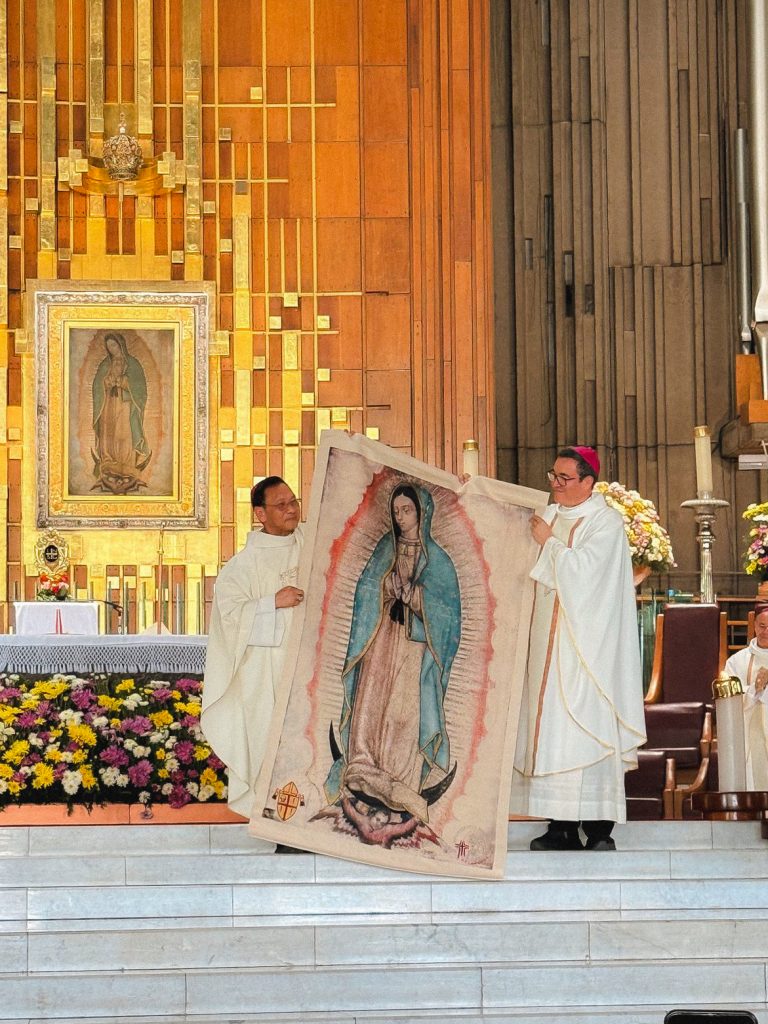
In 1999, Pope St. John Paul II named Mary, under her title of Our Lady of Guadalupe, as the patroness of the Americas.
In 1846, the U.S. bishops chose her, under the title of the Immaculate Conception, as patroness of the United States.
As Our Lady of Refuge, she serves with St. Didacus (San Diego) as co-patron of the Diocese of San Diego.
What has Mary done since the first century?
There have been many reported apparitions of the Blessed Mother over the centuries. To date, 16 have been officially recognized by the Vatican as worthy of belief, while others have received similar approvals at the diocesan level by the local bishop.
Some of the most famous Marian apparitions include: Our Lady of Guadalupe (Mexico, 1531); Our Lady of Lourdes (France, 1858); and Our Lady of Fatima (Portugal, 1917). Others include the apparitions of Our Lady of the Miraculous Medal (France, 1830), who appeared to St. Catherine Labouré and requested the creation of what is known today as the Miraculous Medal, and Our Lady of Kibeho (Rwanda, 1981-1989), who is believed to have warned of the horrors of the Rwandan genocide of 1994.
Has Mary appeared in the U.S.?
The purported “Bayside Apparitions” that Veronica Lueken, a housewife from Bayside, New York, claimed to receive from 1970 until her death in 1995, were condemned by the Church.
But the United States is home to the site of an approved Marian apparition — Our Lady of Champion — in Champion, Wisconsin, where the Blessed Mother appeared in 1859 to Adele Brice. Those apparitions were approved as worthy of belief in 2010 by Bishop David L. Ricken of the Diocese of Green Bay.
You can learn more about this apparition at the website of the National Shrine of Our Lady of Champion, championshrine.org.
How many diocesan parishes are named after Mary?
Twenty-three parishes in the Diocese of San Diego are named after her, including The Immaculata, Immaculate Conception, Mater Dei, Queen of Angels, and three named after Our Lady of Guadalupe. There’s even one named after her mother, St. Anne.
What are some ways to honor Mary beyond May?
In various apparitions, the Blessed Mother has asked the faithful to pray a daily rosary. Have you considered taking up this practice, even if it means starting slowly with a weekly rosary or even a single decade each day? With the rosary available on CD and as a digital download, it’s easier than ever to pray it on a 20-minute commute.
Another way to honor Mary is by practicing the Five First Saturdays Devotion. About eight years after the apparitions at Fatima, Mary appeared again to one of the three visionaries, asking her to promote this devotion. (Catholic Answers lays out the requirements here: catholic.com/qa/first-saturday-devotion-requirements.) To those who perform this devotion, Mary promises “to assist them at the hour of death with all the graces necessary for the salvation of their souls.”
The Church has attached indulgences to the recitation of many Marian prayers, including the rosary, Magnificat, Memorare, and Hail Holy Queen. This means that, in addition to honoring Mary, these prayers can reduce the time that you (or a deceased loved one) will have to spend in Purgatory. A listing of prayers with indulgences attached to them can be found in the “Manual of Indulgences,” viewable online at holyjoe.org/indulgences/Indulgences_1999.pdf.